
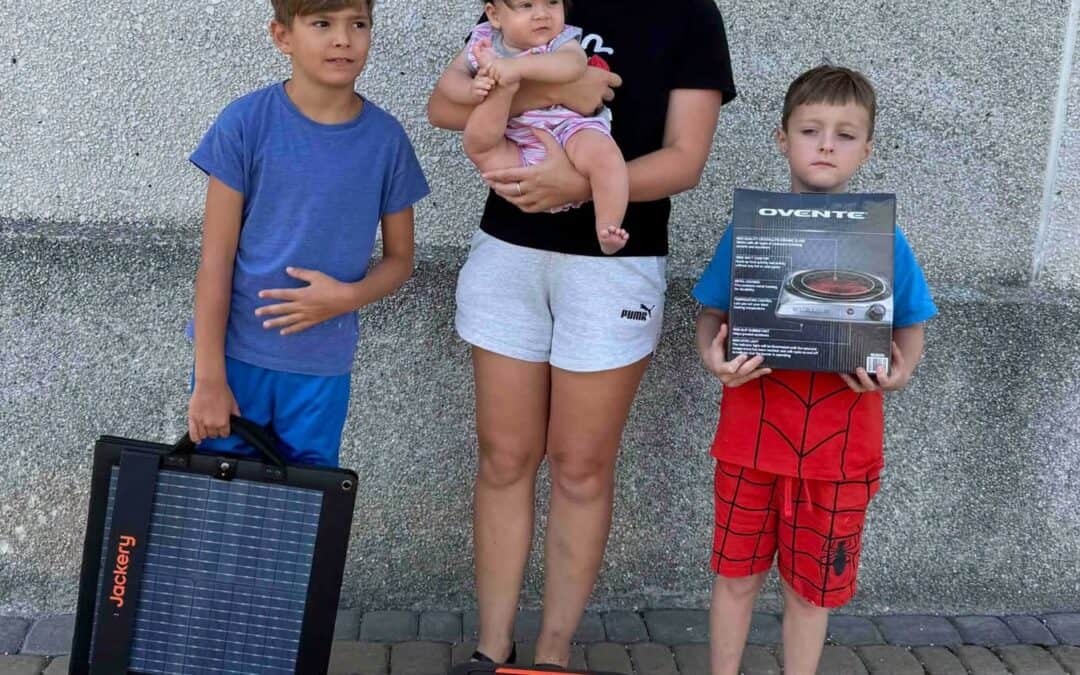
For a family in Ukraine, preparing for winter now means thinking about more than warm clothes and colder nights. It also means asking a question that has become familiar during years of war: What happens if the power goes out again?
For families receiving portable power stations and solar panels through Hope For Ukraine's Solar Energy Resilience Program, that equipment can make a real difference during a blackout.
A family can have light after sunset. A parent can keep a phone charged for emergency alerts and communication. Basic devices can continue to work when electricity from the grid is unavailable.
As another winter approaches, that kind of backup power matters.
Ukraine is entering another winter with an energy system under pressure
Last winter showed just how quickly an attack on energy infrastructure can reach into an ordinary home.
According to the United Nations Human Rights Monitoring Mission in Ukraine, Russian forces repeatedly targeted electricity generation, transmission, distribution, and heating infrastructure during the 2025–2026 winter.
Between October 2025 and March 2026, the UN documented at least 423 attacks on electricity infrastructure and at least 74 strikes on combined heat and power plants and other heating infrastructure.
Those attacks contributed to widespread power outages across the country. At some points, people had electricity for only a few hours each day. Heating and hot water were also disrupted for hundreds of thousands of civilians while temperatures fell below minus 20 degrees Celsius during one of Ukraine's coldest winters in years.
The problem is not only darkness. When electricity disappears, water pumps can stop, communications can become harder, heating systems may fail, schools and healthcare facilities can be disrupted, and families can lose access to things they depend on every day.
The concern is not over with last winter.
In July, the United Nations and humanitarian partners launched the 2026–2027 Winter Response Plan with the goal of reaching 2.1 million vulnerable people across Ukraine. The plan specifically points to repeated attacks on critical energy infrastructure and the effects those attacks have had on electricity, heating, and water.
Winter preparation has to begin before the temperatures fall.
What a solar resilience kit can mean inside a home
It is easy to talk about energy infrastructure in terms of power plants, transmission lines, and megawatts. For families, the situation is much more personal.
It is a child trying to do something after dark. It is a parent checking emergency alerts. It is trying to prepare food or keep a basic device running. It is wondering when the electricity will return and how long it will stay on when it does.
Hope For Ukraine's Solar Energy Resilience Program is meant to provide families with another option when the grid cannot be relied on.
Portable power stations and solar panels can store and provide electricity for basic household needs. They are not a replacement for Ukraine's national power system, but for an individual family during an outage, they can provide something immediate and practical.
For one family, it meant having light during another blackout
We recently received a message from a large family from the Kherson region, from the left bank of the Dnipro.
Their message came during another blackout.
“Ukraine is experiencing another blackout, but we have light.”
“A large family from the Kherson region, from the left bank of the Dnipro, thanks the organization Hope for Ukraine for the charging station. We connected it to an LED lamp via a USB cable, and it provides very good light for the entire room where we spend our time.”
In the video, the room begins in darkness. Then the power station is switched on. The lights come on and children can be seen playing inside the apartment.
It is a small moment, but it explains this program better than statistics can.
Watch what happens when the lights come back on
The family in this video is from the Kherson region. During a blackout, their charging station provided enough power for an LED lamp to light the room where the family was spending its time.
Watch the VideoWhy Hope For Ukraine is preparing now
The hardest part about winter response is that families cannot wait until a blackout happens for preparation to begin.
Solar equipment has to be purchased, transported, delivered, and placed with families before it is needed. That is why Hope For Ukraine is working toward a goal of delivering 1,250 solar energy resilience kits in 2026 to families living in communities affected by war, power outages, and damaged infrastructure.
The need is especially serious for people living closer to the front line, displaced families, older adults, families with children, and people who already have fewer options when electricity and heating disappear.
The United Nations has warned that preparing for winter cannot begin when the first snow falls. Last winter showed why.
A light can seem small until there isn't one
Most of us do not think much about charging a phone or turning on a light. We expect electricity to be there.
For families living through repeated attacks and blackouts, those ordinary things can no longer be taken for granted.
That is what makes these solar resilience kits so important. They do not solve every problem caused by attacks on Ukraine's energy system. They do give a family a way to keep some of the basics working when the power disappears.
And sometimes, as the family from Kherson showed us, that starts with something as simple as turning the lights back on so children can keep playing.
Help a family prepare before winter arrives
Your support helps Hope For Ukraine provide reliable backup power to families facing blackouts, damaged infrastructure, and another difficult winter.
Support Families in UkraineSources and fact-checking
United Nations Human Rights Monitoring Mission in Ukraine, June 29, 2026: report on attacks against Ukraine's energy infrastructure during the 2025–2026 winter.
United Nations in Ukraine, July 22, 2026: 2026–2027 Winter Response Plan targeting 2.1 million vulnerable people.
Hope For Ukraine Solar Energy Resilience Program: 2026 goal of 1,250 solar resilience kits for families in hard-hit communities.