
For most of us, losing power for a few hours is frustrating. We check the outage map, find a flashlight, watch the battery percentage on our phones and wait for the lights to come back on. For families in Ukraine, a blackout can carry a very different weight.
Another winter is getting closer, and Hope For Ukraine is preparing for the possibility that many families in the communities we serve could spend more than eight hours at a time without electricity. In some places, experience from last winter suggests the outages could be even longer.
That is why there is a rush right now to get more solar energy resilience kits into homes before cold weather arrives. The goal is not to replace Ukraine's electricity system. It is to make sure a family still has something to rely on when that system goes down.
Ukraine is entering winter with an energy system that has already been hit hard
Ukraine has spent years repairing its power system while it continues to be attacked. Power plants have been damaged. Transmission infrastructure has been hit. Local distribution networks have been damaged and rebuilt, sometimes more than once.
The 2025–2026 winter showed what happens when enough parts of that system are damaged at the same time.
According to the United Nations Human Rights Monitoring Mission in Ukraine, Russian armed forces repeatedly targeted energy facilities across the country throughout the winter. Those attacks damaged electricity generation, transmission and distribution infrastructure that had already been weakened by earlier strikes.
The result was a large electricity shortage just as temperatures were falling and demand was increasing. Emergency outages affected millions of people, and scheduled rolling cuts were introduced across the country. During some periods, the UN said civilians had electricity for only a couple of hours per day.
Heating infrastructure was also hit. Hundreds of thousands of people lost heating and hot water while temperatures fell below minus 20 degrees Celsius during one of Ukraine's coldest winters in years.
That experience is important when we talk about the possibility of an eight-hour outage this winter. Eight hours is not an extreme scenario pulled out of nowhere. Last winter, many people experienced conditions worse than that.
What eight hours without power actually means inside a home
The words "power outage" can make the problem sound fairly simple. The lights turn off. Eventually, they turn back on.
But electricity is tied to much more than lighting.
A phone needs to stay charged so a family can receive emergency alerts and contact relatives. Apartment buildings may depend on electric pumps for water. Some medical devices need electricity. Food still has to be prepared. Children still need light after sunset. People still need to know what is happening around them.
The UN found that last winter's outages affected water supplies, healthcare, schools and heating, and in some cases pushed people to leave their homes.
An outage can also become harder the longer it lasts. A phone that starts the evening at 50 percent eventually reaches 20 percent. Then 10. A power bank eventually runs out too. The same is true for rechargeable lights and other devices.
That is the problem Hope For Ukraine's Solar Energy Resilience Program is trying to address.
The response is simple: put another source of power inside the home
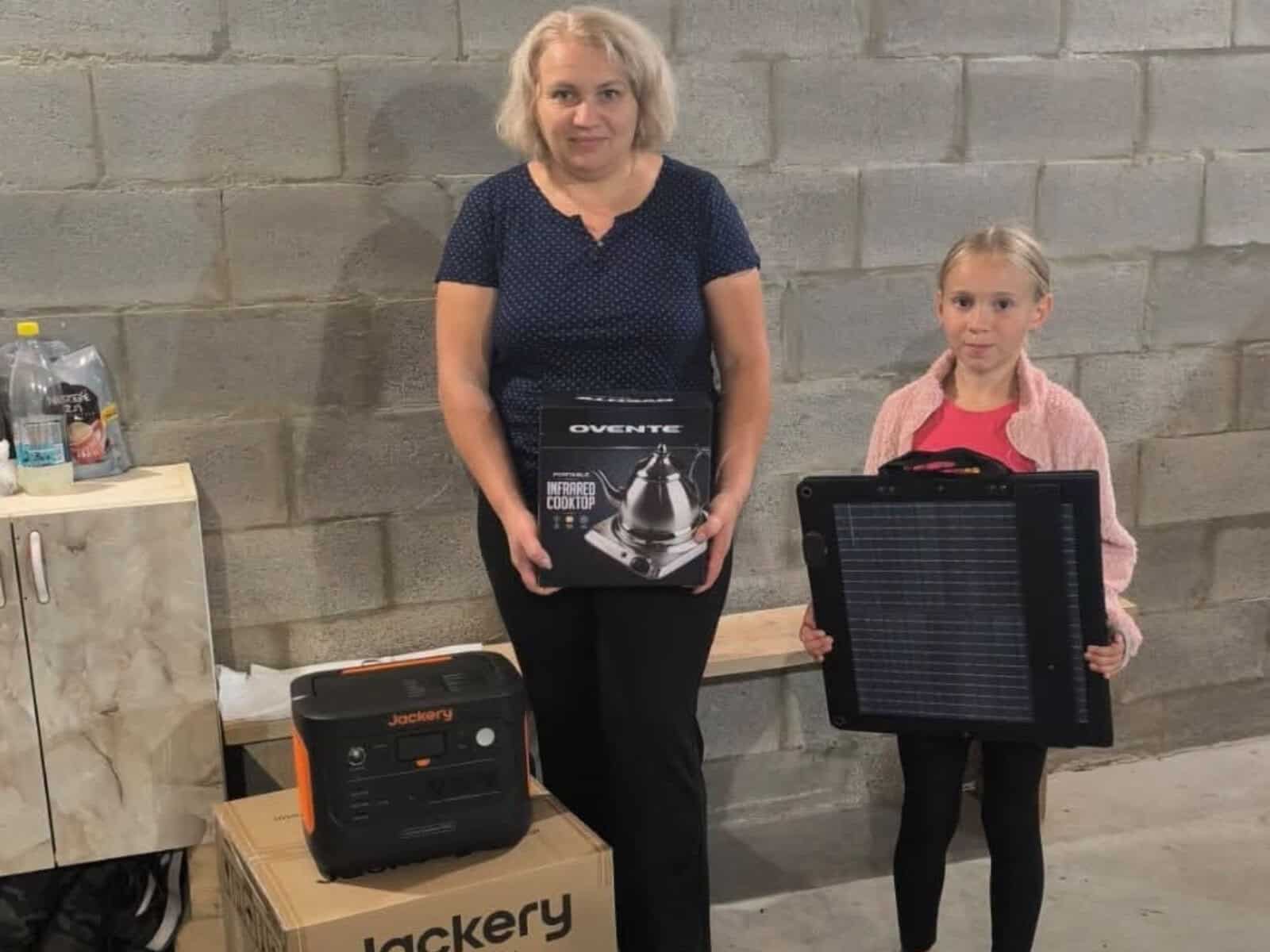
Hope For Ukraine's 2026 goal is to deliver 1,250 solar energy resilience kits to families living in some of the hardest-hit communities in Ukraine.
The idea behind the program is straightforward. If a family has to depend completely on the grid, then a damaged substation, transmission line or power plant can leave that family with nothing. A solar-powered battery system gives them a second option.
It is not unlimited electricity. These systems are meant for the things that matter most during an outage: keeping phones charged, running LED lights, powering communications equipment and supporting selected low-power devices.
In September, Oil & Gas News reported on 600 micro-solar systems being used through Hope For Ukraine's program. The current units are rated at 1,200 watts. According to Hope For Ukraine CEO Yuriy Boyechko, that is enough capacity for practical household needs such as phones, LED lighting, communications equipment, selected low-power medical devices and basic cooking with an electric cooktop.
The systems can also be charged when grid electricity briefly returns. That matters during winter, when solar charging can be slower. If a home receives electricity for only a few hours, the battery can recharge during that window and then continue supplying basic power after the grid goes down again.
Why solar can make sense when a generator does not
A diesel generator is an obvious backup-power option in many places, but it is not a simple solution for every Ukrainian family.
Many of the people Hope For Ukraine serves live in apartment buildings. A generator requires fuel, ventilation and a safe place to operate. Exhaust fumes make indoor operation dangerous, while fuel storage, noise and fire risk create other problems.
Solar-powered battery systems work differently. They can provide electricity inside an apartment without running an engine or depending on repeated fuel deliveries.
That last point matters during war. Fuel infrastructure and supply routes can also be damaged or disrupted. Razumkov Centre's September review of Ukraine's energy sector noted that fuel infrastructure itself has become a target, adding another layer of difficulty for backup systems that depend on a steady supply of fuel.
Ukraine's power system is stronger than it was, but the risk has not disappeared
There has been progress. That is important to say.
Ukraine avoided prolonged electricity restrictions during much of summer 2026. More distributed power generation has been added. Energy storage has expanded. Repairs are continuing, and new equipment has been brought into the country.
Razumkov Centre reported in September that July was the third month of 2026 without prolonged electricity restrictions for households and industrial consumers.
But the researchers also warned against reading too much into a relatively stable summer. Their analysis said the power system's resilience margin remains limited and still depends heavily on weather, maintenance, available generation and how effectively the system can be managed.
Most importantly, energy infrastructure remains a target.
Winter changes the equation as well. Electricity and heating demand rise just as cold weather can make damaged infrastructure harder to repair. That is why preparation has to happen while there is still time.
No one can responsibly say today that every Ukrainian family will lose power for a specific number of hours this winter. Outages depend on the region, weather, available generation and what happens to the grid. What we do know is that prolonged outages happened last winter, and the risk has not gone away.
The United Nations is preparing for another difficult winter too
In July, the United Nations and humanitarian partners launched their 2026–2027 Winter Response Plan. The plan is seeking to help 2.1 million vulnerable people across Ukraine between the fall and the end of winter.
The UN pointed directly to attacks on critical energy infrastructure as one of the reasons that preparation is needed. Last winter, those attacks disrupted electricity, heating and water for millions of people, both near the front line and in cities farther away.
That does not mean every community will experience the same conditions this winter. It does mean humanitarian organizations cannot wait until a major outage has already happened to start moving equipment.
Solar systems have to be funded and purchased. They have to be shipped into Ukraine. They have to reach the communities where they are needed, including places where transportation itself can be difficult. Families also need to know how to charge them, where to place the panels and which devices should be prioritized when power is limited.
Hope For Ukraine's work continues after a system is handed over. Local volunteers check in with families, answer questions and help make sure the equipment remains useful through repeated outages.
This is why the rush is happening before winter, not during it
There is a tendency to think about winter aid once the weather becomes cold. By that point, much of the work should already be done.
A family cannot wait for a container to cross the Atlantic after their neighborhood has already lost electricity. The equipment has to be there first.
According to Hope For Ukraine's September interview with Oil & Gas News, each complete current solar-powered unit costs $800. That includes the system itself, transportation into and within Ukraine, recipient training and continued local support.
The cost is important, but what it represents is easier to understand inside a home.
It means a mother can charge her phone while the neighborhood is dark. It means children can have light in the room where they are sitting. It means a family does not have to use the last percentage of a battery wondering when electricity will return.
It is a relatively small amount of power compared with the scale of Ukraine's national energy system. For the family using it, the difference is not small at all.
Solar power cannot repair the grid. It can help a family live through its failure.
Ukraine's energy challenge is much larger than any one humanitarian program. Power plants have to be repaired. Transmission networks have to be protected and rebuilt. More generation and storage are needed across the country.
Household solar systems are one part of that much bigger picture.
But there is something important about putting electricity directly in a family's hands.
When the grid works, the system can recharge. When the grid disappears, the family still has a source of power. They do not have to wait in complete darkness for someone somewhere else to fix the problem.
That is what energy resilience looks like on a very human scale.
Another Ukrainian winter is getting closer. We do not know exactly what the coming months will bring. We do know what happened last winter, and we know families are safer when they have another option.
That is why Hope For Ukraine is moving solar energy resilience kits now, before the lights go out.
Sources and fact-checking
United Nations Human Rights Monitoring Mission in Ukraine, June 29, 2026: Attacks against Ukraine's energy infrastructure and update on the human rights situation in Ukraine .
United Nations in Ukraine, July 22, 2026: 2026–2027 Winter Response Plan .
Hope For Ukraine: Solar Energy Resilience Program .
Razumkov Centre, September 4, 2026: Ukraine's Energy Sector in July 2026 .
Oil & Gas News, September 1, 2026: Micro-Solar Units Bring Off-Grid Power for Thousands Across War-Torn Ukraine .
Help get power to a family before the lights go out.
Your gift helps Hope For Ukraine deliver solar energy resilience kits to families facing long blackouts, damaged infrastructure and another difficult winter.
Donate to Hope For Ukraine