
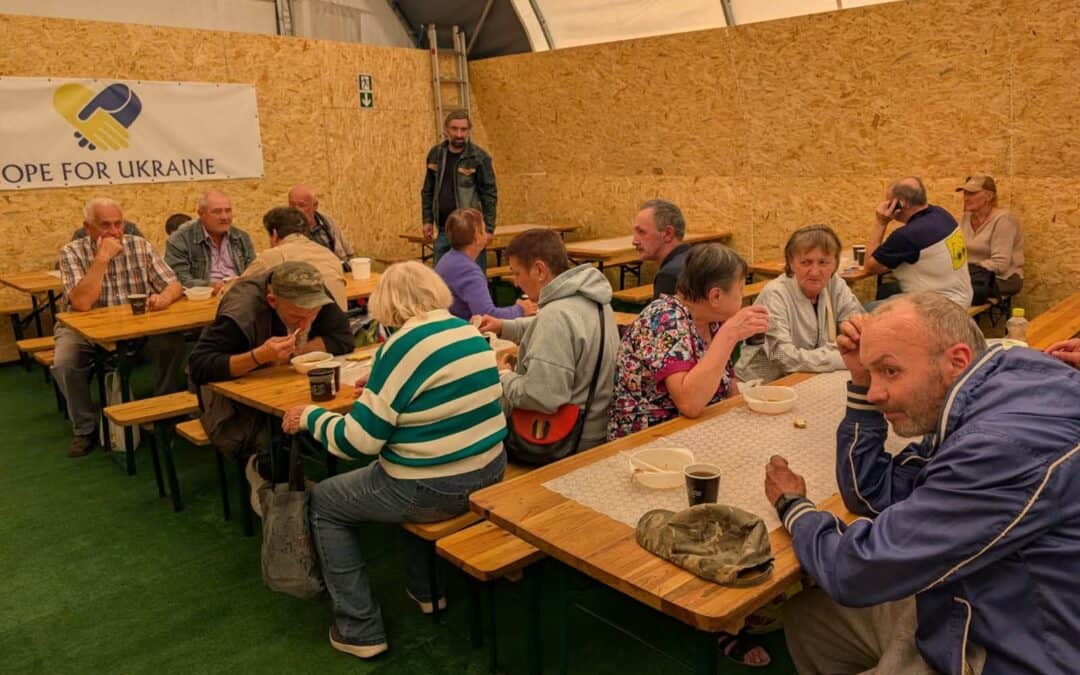
Safe shelter still matters in Ukraine because displacement is not over. Millions of people remain away from their homes, and families continue to leave communities affected by fighting, damaged housing, and unreliable basic services. For someone who has just fled home, shelter provides much more than a place to sleep. It can mean heat, food, running water, medical help, stability for children, and enough time to figure out what comes next.
As of July 2026, the International Organization for Migration estimated that about 3.45 million people were internally displaced within Ukraine. These are people who have been forced to leave their homes but remain elsewhere inside the country. Some are staying with relatives or renting temporary housing. Others rely on shelters and humanitarian support because they have nowhere safe or affordable to go.
Displacement can last far longer than the first evacuation. A family may leave home in a matter of hours, but rebuilding stability can take months or years. That is why temporary shelter remains an important part of Ukraine’s humanitarian response even more than four years into the full-scale war.
Why shelter still matters: leaving danger does not immediately solve a family’s housing, food, medical, employment, transportation, or education needs. A safe place to stay gives people a stable starting point for dealing with everything that comes after displacement.
Why Are Families Still Being Displaced in Ukraine?
Families continue to leave their homes for many of the same reasons that drove displacement earlier in the war: fighting near their communities, attacks on civilian areas, damaged homes, and interruptions to electricity, heating, water, transportation, and health services. In frontline areas, conditions can change quickly, leaving families with little time to decide whether to stay or leave.
Displacement also does not always happen only once. A family may first move from a frontline village to a nearby city, then have to relocate again if conditions worsen. Others leave temporarily expecting to return, only to discover that their home has been damaged or that basic services have not returned.
That helps explain why the number of internally displaced people remains so high. IOM reported roughly 3.39 million displaced people in January 2026 and about 3.45 million by July, showing that displacement continues to be an active humanitarian issue rather than only a legacy of the first years of the war.
What Does Safe Temporary Shelter Actually Provide?
When people hear the word “shelter,” it is easy to picture a room and a bed. Those are essential, but they are only part of what a displaced family may need. Someone arriving after an evacuation may have traveled for hours or days, may have very few belongings, and may not know anyone in the community where they have arrived.
A functioning shelter can provide a reliable address, heat, electricity, water, showers, meals, clothing, hygiene items, and help connecting with medical services. For parents, it can also create enough stability to enroll children in school, look for work, replace documents, arrange transportation, or search for longer-term housing.
The value of shelter is therefore not only physical protection. It gives people breathing room. Instead of solving every problem at once while worrying about where they will sleep that night, a family has a stable place from which to begin making decisions.
Why Can’t Displaced Families Simply Go Home?
Returning home is often more complicated than whether fighting has moved farther away. A home may be damaged or destroyed. The neighborhood may no longer have dependable electricity, heating, water, health care, public transportation, or nearby schools. Jobs and local businesses may also have disappeared.
Even when a building is still standing, a safe and sustainable return depends on whether daily life can actually resume there. A family with young children, an older relative, or someone who needs regular medical care may not be able to return to a community where essential services remain unreliable.
That is why humanitarian organizations look not only at whether people can physically return, but whether they can return safely and remain there.
What Happens When Displacement Lasts for Months or Years?
The needs of a displaced family change over time. During the first few days, the priorities may be shelter, food, clothing, and medicine. After several weeks or months, questions about employment, school, rent, transportation, and long-term housing become more important.
A parent who initially asked, “Where can we sleep tonight?” may later be asking whether they can afford an apartment, whether their children can stay in the same school, or whether it is realistic to keep waiting to return home. Older adults may be deciding whether to rebuild in a new city while also trying to maintain medical care and social connections.
Temporary shelter is not meant to be the final answer to displacement. Its role is to provide stability while people work toward something more permanent.
Why Shelter Becomes Even More Important in Winter
Cold weather makes unstable housing more dangerous. A damaged home that is difficult to live in during mild weather can become unsafe when temperatures fall below freezing, especially if heating, electricity, or water are unreliable.
The United Nations’ 2026–2027 Winter Response Plan aims to help 2.1 million people between October 2026 and March 2027. Newly displaced and evacuated people are among the groups specifically prioritized, along with people living close to the front line and those affected by attacks on civilian infrastructure.
Winter assistance includes shelter repairs, heating support, food, health care, protection services, and cash assistance. The reason these services are grouped together is simple: staying safe through winter is rarely about one need alone.
How Hope for Ukraine Helps Displaced Families
Hope for Ukraine’s Refugee Program provides temporary shelter and practical daily support for people forced from their homes by the war. Since the beginning of the full-scale invasion, Hope for Ukraine has welcomed and sheltered more than 1,300 displaced people.
The HFU mission center typically houses around 80 residents at a time. Families staying there receive more than a room. The program provides meals, clothing, utilities, medical assistance, and daily support while residents rest, recover, and work through their next steps.
1,300+ people sheltered. Hope for Ukraine has welcomed more than 1,300 displaced people into safety since the start of the full-scale war.
About 80 residents at a time. HFU’s mission center provides temporary accommodation and practical care for families who need somewhere safe to stay.
HFU’s shelter work also shows why the phrase “safe shelter” means more than housing alone. Families may need help obtaining clothing, getting children settled, arranging medical care, or simply having regular meals while they adjust to a new environment.
What Does Safe Shelter Mean for Children?
Displacement can remove several familiar parts of a child’s life at once. Home changes, school may change, friends may be far away, and parents may be dealing with financial and emotional pressure of their own. A shelter cannot replace the home a child has lost, but it can restore some predictability.
Knowing where they will sleep, having regular meals, keeping belongings in one place, and having somewhere to do schoolwork can help rebuild a basic daily routine. These may sound like ordinary things, but ordinary routines become important when so much else has changed.
What Does Safe Shelter Mean for Parents?
Parents arriving in a new community often have several urgent tasks at the same time. They may need to replace documents, find employment, enroll children in school, arrange medical appointments, look for permanent housing, and manage transportation.
Trying to handle those responsibilities while also searching for a different place to sleep every few nights makes rebuilding much harder. Temporary shelter gives parents something that is difficult to measure but extremely useful: time and stability.
It gives them a place to make phone calls, fill out paperwork, search for work, plan for their children, and decide whether returning home is realistic.
Why Safe Shelter Is Part of Recovery, Not Just Emergency Response
Humanitarian shelter is sometimes treated as the first step after evacuation, but it also plays a role in longer-term recovery. Families need somewhere stable enough to move from emergency decisions toward more permanent ones.
That may mean finding an apartment in a new city, returning home after repairs, moving closer to relatives, or starting over in a different community. The path is different for every family, but it is difficult to make any of those decisions without first having somewhere safe to stay.
This is why shelter continues to matter even years into the war. Displacement is not only about the moment someone leaves. It is about everything required to build stability afterward.
Help Provide Safe Shelter for a Displaced Family
Hope for Ukraine provides shelter, meals, clothing, utilities, medical assistance, and practical care for families forced from their homes by war.
Help Provide Safe Shelter →Safe Shelter Gives Families a Place to Begin Again
A displaced family does not stop needing help once they reach a safer city. They still need somewhere to live, reliable food, access to medicine, a way for children to continue school, and enough stability to think about the future.
Some families will eventually return home. Others will build new lives somewhere else. Many still do not know which of those paths will be possible.
Until they do, safe temporary shelter provides something fundamental: a place where people can stop moving, regain a sense of stability, and begin deciding what comes next.
Frequently Asked Questions About Displaced Families in Ukraine
How many people are internally displaced in Ukraine in 2026?
The International Organization for Migration estimated approximately 3.45 million internally displaced people in Ukraine as of July 2026.
What is an internally displaced person?
An internally displaced person, or IDP, is someone who has been forced to leave their home but remains within their own country. In Ukraine, many families have moved from frontline or heavily affected communities to safer areas elsewhere in the country.
Why do displaced families still need shelter?
Families may be unable to return because homes are damaged, communities remain unsafe, or essential services such as electricity, water, health care, transportation, and schools are not reliably available.
What does temporary shelter provide beyond a bed?
Temporary shelter can provide heat, electricity, water, meals, clothing, hygiene items, medical assistance, and a stable place from which families can search for work, enroll children in school, and plan their next steps.
How does Hope for Ukraine help displaced families?
Hope for Ukraine’s Refugee Program provides shelter, meals, clothing, utilities, medical assistance, and daily care. HFU reports that more than 1,300 displaced people have been sheltered through the program.