
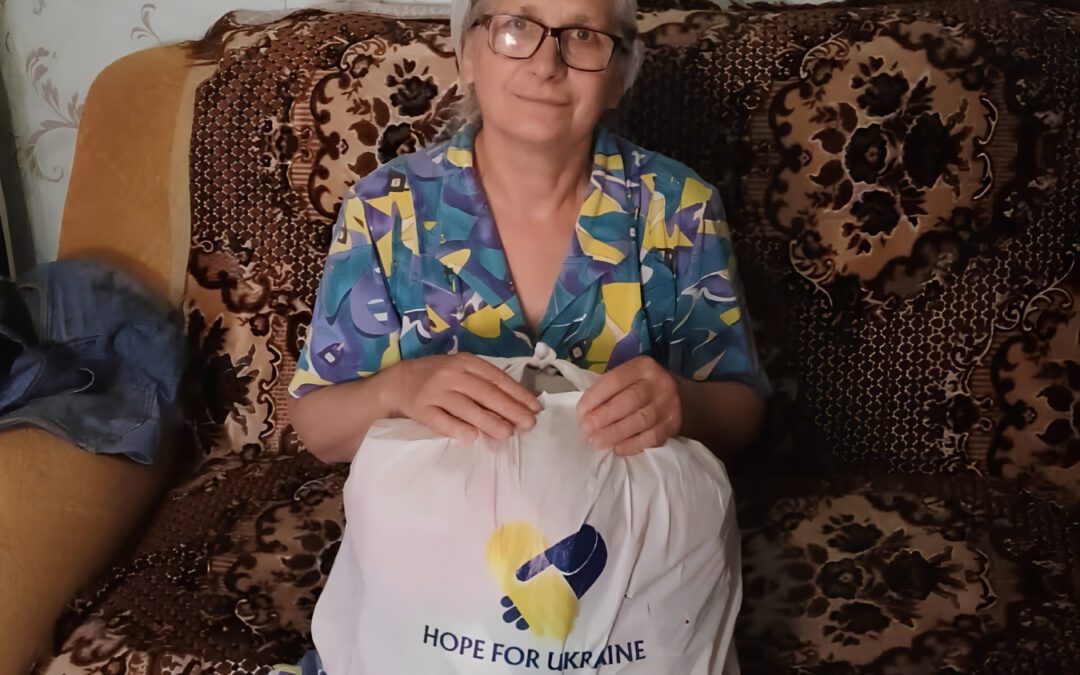
A woman sits on a patterned sofa inside her home, holding a white Hope For Ukraine food bag in her lap. Her hands rest on the top of the bag as she looks toward the camera with a quiet smile.
We do not know every part of her story. What we do know is that this food reached her through Hope For Ukraine, and that scenes like this continue to repeat themselves across the communities we serve.
For most of us, bringing groceries home is an ordinary part of the week. We shop, unpack the bags, put food in the cupboards and begin thinking about the next meal. Across Ukraine, four years of full-scale war have made that routine far less certain for many families.
The World Food Programme currently estimates that about 2 million people in Ukraine need food and livelihoods assistance. Near the front line, daily shelling, drone attacks, unsafe roads and closed supermarkets can make food harder to reach. Even where stores remain open, lost jobs and reduced incomes have left some households struggling to afford what they need.
The challenge is part of a much larger humanitarian crisis. The United Nations estimates that 10.8 million people in Ukraine need humanitarian assistance in 2026, with people living near the front line, displaced families and other vulnerable households among those facing the greatest needs.
At Hope For Ukraine, we see what those numbers look like at the household level.
They look like a food bag carried through a front door. They look like groceries placed on a kitchen table. They look like families knowing that, for the coming days, there will be something available when it is time to prepare a meal.
Through our Hope Begins With A Meal campaign, we provide food kits to people affected by the war. Each $25 kit can provide a family of four with groceries for approximately seven to ten days. We are currently working to increase our distribution from about 1,700 food kits each week to 2,000. Those are figures from our own 2026 campaign materials, and they represent the scale of what our teams are trying to accomplish week after week.
A food kit cannot undo what war has taken from a family. It cannot rebuild a damaged home, restore a lost job or remove the uncertainty that comes with another night of air raid alerts.
What it can do is answer one immediate question: What are we going to eat?
That answer matters.
When a person is already stretching a limited income across medicine, utilities, transportation and other necessities, having groceries at home can take one concern off the list. When normal supply routes have been disrupted, it means food has reached a place where getting it is no longer simple. When someone has spent years living with uncertainty, it offers something practical they can use that same day.
The need for this kind of assistance remains enormous. The World Food Programme says it is currently reaching more than 600,000 people each month in Ukraine, with food assistance focused heavily on hard-to-reach and frontline communities where commercial supply lines have been disrupted.
Our work is one part of that much larger response.
Every week, our teams continue preparing food kits and getting them into the hands of people who need them. We want to reach 2,000 households each week because behind every distribution number is a person opening a bag, putting food away and knowing there will be meals in the days ahead.
That is what we see when we look at this photograph.
We see a woman sitting in her home with a Hope For Ukraine bag in her hands. We see a simple delivery that has reached the person it was meant for. And we are reminded that humanitarian aid does not always arrive in a dramatic moment.
Sometimes, it looks like groceries on the way to the kitchen.
When you support Hope Begins With A Meal, you help us continue bringing food directly to families and individuals across Ukraine who are trying to make it through another week of war.
About the Author
Evan Raftes serves as the Marketing and Community Engagement Manager at Hope For Ukraine, sharing the stories of Ukrainian communities and connecting supporters with meaningful ways to help children and families affected by the war.