
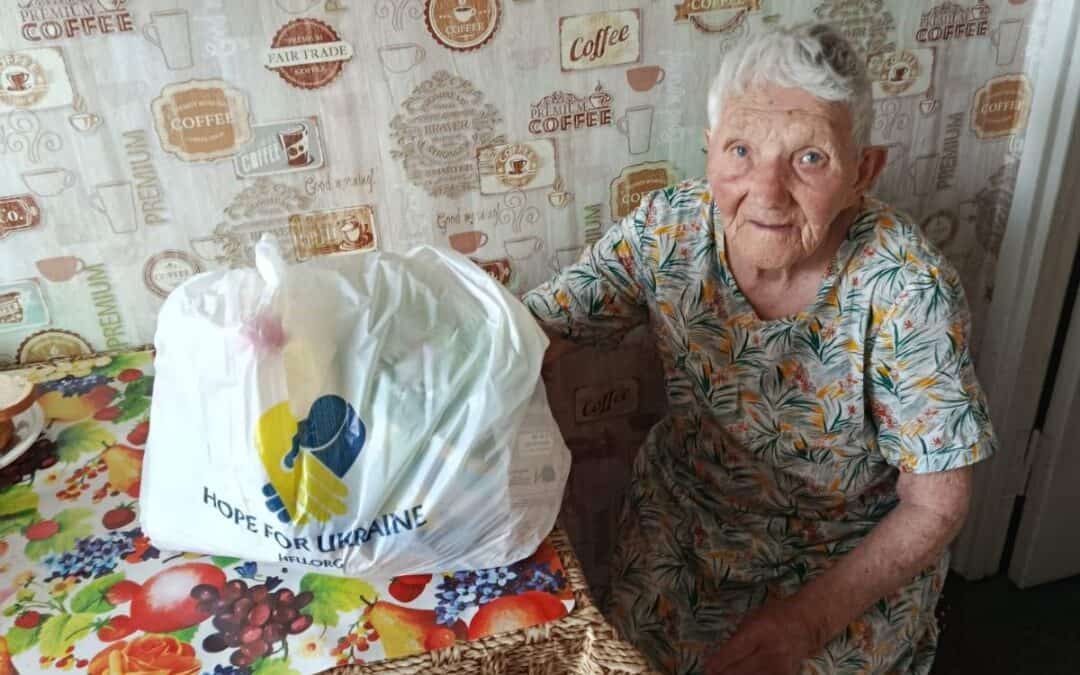
She is sitting beside her kitchen table, looking straight into the camera. Her white hair is pulled back, she is wearing a floral dress, and beside her is a white Hope For Ukraine aid bag.
It is a simple photograph from inside a home. There is no warehouse full of supplies and no large distribution line. There is one woman, one table, and help that has reached her door.
For us, that is where the story of food relief in Ukraine becomes real.
Across Ukraine, elderly people are among those having the hardest time keeping enough food at home as the war continues and everyday costs remain high.
The problem is not that Ukraine has simply run out of food. The reality is more complicated. Food may exist in the country, while the people who need it most still struggle to afford it or reach it.
The World Food Programme estimated in February 2025 that about 5 million Ukrainians were facing food insecurity, with the greatest needs concentrated in areas close to the front lines. WFP also reported families using painful coping strategies, including adults eating less so their children could eat and households taking on debt just to buy enough food.
More recent reporting shows why this pressure has not disappeared.
In its August 2026 Ukraine update, the Famine Early Warning Systems Network identified elderly people, displaced families, and low-income households as some of the groups struggling most with food access. Food prices remain another part of the problem. Compared with the previous year, bread prices were reported to be 19.4% higher, while sunflower oil was 20.8% higher.
Those percentages can sound distant until you picture the woman in this photograph.
For someone living on a small or fixed income, a higher grocery bill cannot always be absorbed. There may be medicine to pay for. There may be utilities, transportation, or repairs. For people living closer to areas affected by fighting, getting to a store can become another problem entirely.
Shelling, unsafe roads, shop closures, and damage to local livelihoods continue to make food harder to access in communities near the front. FEWS NET reported that these local disruptions are hurting incomes and market access even while Ukraine’s overall national food supply remains available.
That distinction matters.
Hunger can exist even when food is sitting on a shelf somewhere else.
It exists when an elderly person cannot afford what is on that shelf. It exists when the nearest store is difficult to reach. It exists when prices rise faster than income. It exists when war has changed the ordinary act of buying groceries into another source of uncertainty.
This is why Hope For Ukraine continues delivering direct food assistance.
Our local teams, volunteers, and trusted partners work to get practical help into the hands of people who need it. Food assistance helps families and seniors put basic meals on the table without having to make another impossible decision about what expense can wait.
You can learn more about the work Hope For Ukraine is doing across the country on our What We Do page.
And then there are moments like the one in this photograph.
A Hope For Ukraine bag has made it all the way inside someone’s home. The distance between a donor and the person receiving help suddenly feels much smaller.
For the woman sitting beside that table, assistance means there is something at home she can depend on. For another senior, it could mean avoiding a difficult trip carrying groceries. For another family, it could mean being able to prepare dinner after money has already been stretched as far as it can go.
These are ordinary needs. That is exactly why they matter so much.
Years into this war, there is a danger that the world begins to see Ukraine as a story it already understands. Another attack. Another damaged building. Another winter. Another humanitarian statistic.
The people living through it do not have the option to move on.
They still wake up and need breakfast. They still need bread, cooking oil, vegetables, and something warm to eat. Elderly Ukrainians still have to make their pensions and savings last through another week of rising costs and uncertainty.
The woman in this photograph should not disappear into another number.
Neither should the millions of people represented by the statistics surrounding her.
When you donate to Ukraine through Hope For Ukraine, you help our teams continue putting practical assistance into the hands of people who are still living with the consequences of this war every day.
You help another bag reach another kitchen table.
You help another senior know that someone remembered to come.
And right now, that still matters.
About the Author
Evan Raftes serves as the Marketing and Community Engagement Manager at Hope For Ukraine, sharing the stories of Ukrainian communities and connecting supporters with meaningful ways to help children and families affected by the war.