
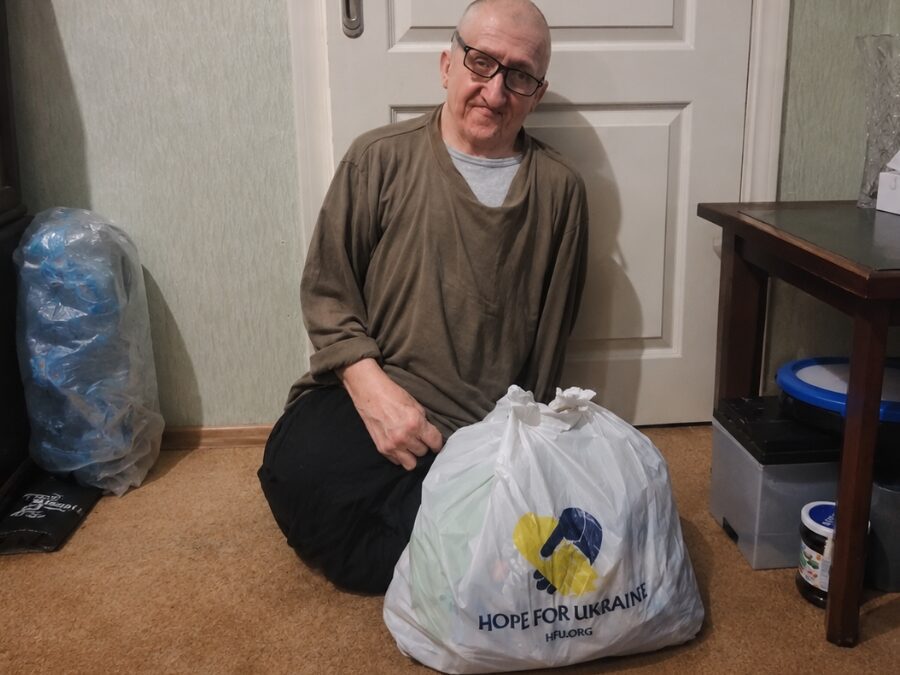
When Hope For Ukraine’s team reached the small room where an older man had been living alone, they found him seated on the floor beside a closed door. A large white aid bag filled with food now rested at his side.
Before that visit, 90 days had passed without anyone coming to see him.
No family member. No neighbor. No familiar voice asking how he was doing or whether he needed anything.
We are calling him Vasyl to protect his privacy. His name has been changed, but the isolation he experienced is real. By the time our team arrived, he did not ask for much. He had stopped expecting anyone to come at all.
The war in Ukraine is often measured through front lines, missile attacks, destroyed homes, and the number of people forced to flee. Less visible is what happens inside the homes that remain.
Families become separated as relatives leave in search of safety. Communities grow quieter as neighbors relocate, enlist, or struggle to care for their own households. The people who once checked on an older resident may now be living in another city or another country.
For older Ukrainians who remain behind, the effects of war can be painfully quiet.
There may be no dramatic moment that reaches the news. Instead, days pass behind the same closed door. A familiar knock stops coming. Conversations become rare. The circle of people nearby grows smaller until there is no one left to notice how long a person has been alone.
For Vasyl, that silence lasted three months.
We do not know every detail of how he spent those 90 days, and we will not invent them. We know that no relative or neighbor visited. We know that when our team reached him, he did not expect anyone to be standing outside his door.
The food they carried inside gave him something immediate and practical. It meant he would not have to face the coming days without basic support.
But the visit meant more than what was inside the bag.
Someone had learned that Vasyl was there. Someone had come through the door. After months without a visitor, another person was finally sitting in the room with him.
That human contact cannot replace everything the war has taken from Ukraine’s older generation. It cannot reunite every separated family or rebuild every community that has been scattered. But it can break the silence. It can tell someone who has been overlooked that his life has not disappeared from view.
Through Hope For Ukraine’s Family Support Program, teams provide food, hot meals, and essential supplies to families, displaced people, and older residents affected by the war. Sometimes that assistance is distributed to an entire community. Other times, it must be carried through one door to reach one person living alone.
These visits matter because isolation can hide suffering from everyone outside the room. A person who does not ask for help can easily be missed. Someone who has grown accustomed to being alone may no longer believe that help is coming.
Vasyl did not need a speech or a promise that everything would suddenly be better. He needed food. He needed another person to enter the room. He needed proof that, after 90 days of silence, he had not been erased.
His story is one example of a part of this war that rarely reaches the front page. Across Ukraine, older people are trying to hold on while the families, neighbors, and routines that once surrounded them have been disrupted.
Their needs do not become less important simply because they are hidden behind closed doors.
When you support Hope For Ukraine, you help our teams continue carrying food and essential assistance to people who may otherwise remain unseen. Sometimes helping Ukraine begins with reaching one small room, knocking on one closed door, and reminding one person that he has not been forgotten.
About the Author
Evan Raftes serves as the Marketing and Community Engagement Manager at Hope For Ukraine, sharing the stories of Ukrainian communities and connecting supporters with meaningful ways to help children and families affected by the war.