
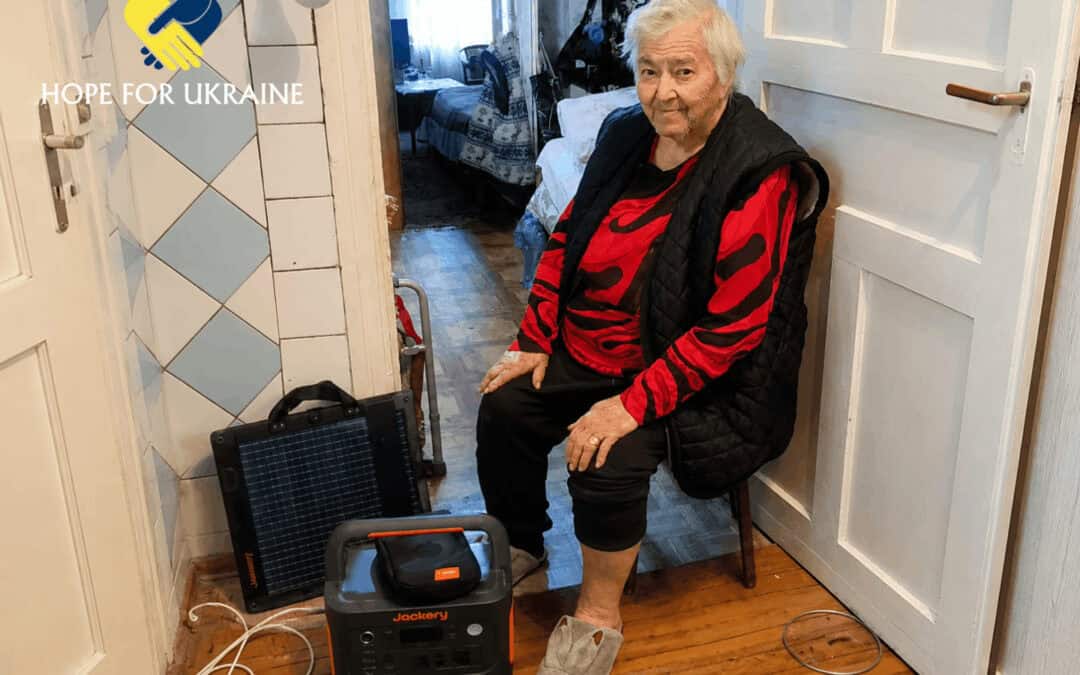
Inside a Ukrainian home, an older woman sits near a doorway with her hands resting on her knees. Beside her are two pieces of equipment that can change what happens the next time the electricity disappears: a portable solar panel and a power station.
It is one delivery for one woman. One solar panel and one power station.
The cables are gathered on the floor, the equipment is close enough to reach, and the woman watches quietly as it is brought into her home. She did not ask for much. What arrived was a practical answer to something the war had taken away: the certainty that she could turn on a light.
During a blackout, that certainty matters. The power station can keep a small light working, charge a phone, and help run basic devices. The solar panel provides a way to recharge it even when the electrical grid remains unavailable.
For an older person, those simple tasks can determine whether she can receive an emergency alert, contact someone for help, or safely move through her home after dark.
Across Ukraine, electricity can no longer be treated as something that will always be there. A June 2026 report from the United Nations Human Rights Monitoring Mission found that repeated Russian attacks during the 2025–2026 winter damaged generation, transmission, and distribution systems across the country.
At times, scheduled cuts left civilians with electricity for only a few hours a day. The report also found that older people and people with disabilities suffered disproportionate harm when electricity, heat, and water stopped working.
The effects reach far beyond a dark room. Elevators stop, leaving people with limited mobility unable to leave upper floors. Phones lose power. Water may stop reaching apartments. Food becomes harder to store, and electric stoves cannot be used to prepare a hot meal.
During the winter, the loss of electricity can also mean the loss of heat. United Nations monitors documented how prolonged outages disrupted heating and water for millions of people. Hospitals postponed procedures, schools closed, and some residents had to leave homes that had become dangerously cold.
The crisis has not ended with warmer weather. Reuters reported in June that Ukraine was expected to face summer power shortages after Russian attacks damaged more than half of the country’s generation capacity during the previous winter. In Kyiv, some winter outages lasted 14 to 16 hours.
The possibility of more attacks means families still need a backup plan long after the coldest months have passed.
Hope For Ukraine’s Solar Energy Resilience Program is built around that reality. In 2026, the organization is working to deliver 1,250 solar resilience kits to families and individuals in hard-hit communities.
Each kit is designed to provide practical backup power for lighting, phone charging, communication, and other basic household needs when the grid fails.
The equipment beside this woman is part of that work. It is not a replacement for Ukraine’s damaged power system, and it cannot remove the danger surrounding her community. It can, however, give her something reliable inside her own home.
When the electricity goes out, she does not have to sit in complete darkness and wait for the grid to return.
One photograph cannot show the full scale of Ukraine’s energy crisis. Beyond this doorway are thousands of older civilians, including many who live alone, facing repeated blackouts with no dependable source of backup power.
Some are waiting through outages that last for hours. Others are preparing for another winter while repairs remain vulnerable to the next missile or drone attack.
That is why this work does not stop after one delivery. Hope For Ukraine teams will continue placing solar panels and power stations into homes where a charged phone, a working light, and the ability to prepare something warm can make daily life safer.
When you support Hope For Ukraine, you help us continue delivering solar energy resilience kits to people who cannot depend on the grid. For one woman, it means light in her home. Multiplied across Ukraine, it means thousands of people facing the next blackout with a plan.
About the Author
Evan Raftes serves as the Marketing and Community Engagement Manager at Hope For Ukraine, sharing the stories of Ukrainian communities and connecting supporters with meaningful ways to help children and families affected by the war.