
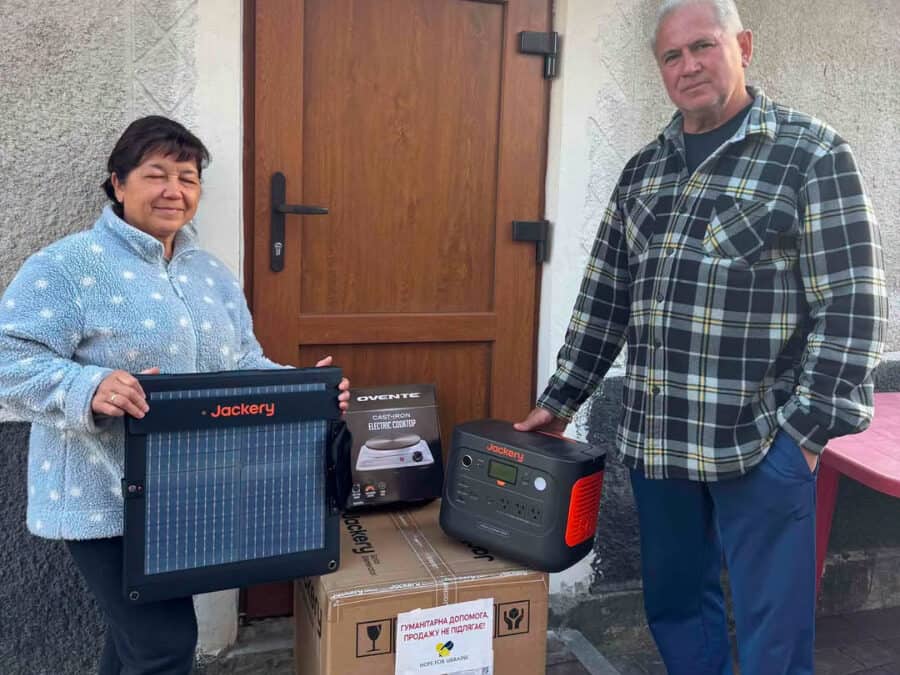
In the photograph, the equipment is easy to count. A woman holds a foldable solar panel while a man stands beside a portable power station. Between them is a boxed single-burner electric cooktop. On the larger cardboard box below, a Hope For Ukraine label identifies the shipment as humanitarian aid.
It is a compact collection of equipment compared with the scale of Ukraine’s energy crisis. But inside a home that suddenly loses electricity, each piece has a very practical purpose.
A charged power station can keep a phone working. A solar panel provides a way to recharge without depending entirely on the electrical grid. A small electric cooktop gives a household another option for preparing food when normal power is unavailable. A light can stay on after dark.
These are ordinary routines until electricity disappears.
Ukraine is preparing for another winter with an energy system that has already endured years of Russian missile and drone attacks. In January, Reuters reported that Ukrainian officials had told foreign diplomats that all of the country’s major energy plants had been damaged or ruined. Several months later, Reuters reported that all of Ukraine’s thermal power plants had been attacked, with Ukrainian officials saying as much as 80% of thermal generation capacity had been lost.
The consequences reach far beyond whether a lamp turns on.
A June report from the United Nations Human Rights Monitoring Mission in Ukraine found that Russian attacks during the 2025-26 winter damaged generation, transmission and distribution infrastructure across the country. At some points, electricity cuts left civilians with power for only a few hours a day. The outages also disrupted water supplies, healthcare, schools, heating and hot water.
And the attacks on energy infrastructure have not stopped with warmer weather. On August 9, Reuters reported that Russian attacks damaged power facilities in the Odesa region, causing significant outages before electricity was restored to 90,000 consumers.
For families living near the frontline, that uncertainty is especially difficult. They are already living with the risks of war, damaged infrastructure and changing security conditions. An extended blackout adds another problem to almost every part of the day, from preparing a meal to receiving an emergency alert.
That is why our team at Hope For Ukraine is working around the clock to place as many Solar Energy Resilience Kits as possible with families in hard-hit communities.
Our 2026 goal is to deliver 1,250 kits. Each one is intended to provide practical backup power for basic household needs when the electrical grid is damaged, unreliable or unavailable. The equipment is not a replacement for Ukraine’s power system, and it cannot erase the damage caused by repeated attacks. What it can do is give a household another option when the power stops.
That distinction matters.
For someone facing another blackout, resilience may look like being able to charge a phone before the battery reaches zero. It may mean having enough light to move safely through a room after sunset or being able to prepare something warm to eat while waiting for electricity to return.
The kit in this photograph is one example of what that preparation looks like in real life. A panel, a power station and a cooktop are sitting outside a doorway today so that basic routines have a better chance of continuing when the grid cannot.
As colder months approach, our team will continue moving these systems toward families facing the greatest uncertainty. Ukraine’s national energy system will require enormous repairs, but households cannot wait for every damaged plant, substation and power line to be rebuilt.
When you support Hope For Ukraine, you help us continue putting practical backup power into the hands of families who may otherwise be left waiting in the dark.
Learn more about Hope For Ukraine’s Solar Energy Resilience Program or help us continue delivering solar energy kits to Ukrainian families.
About the Author
Evan Raftes serves as the Marketing and Community Engagement Manager at Hope For Ukraine, sharing the stories of Ukrainian communities and connecting supporters with meaningful ways to help children and families affected by the war.