
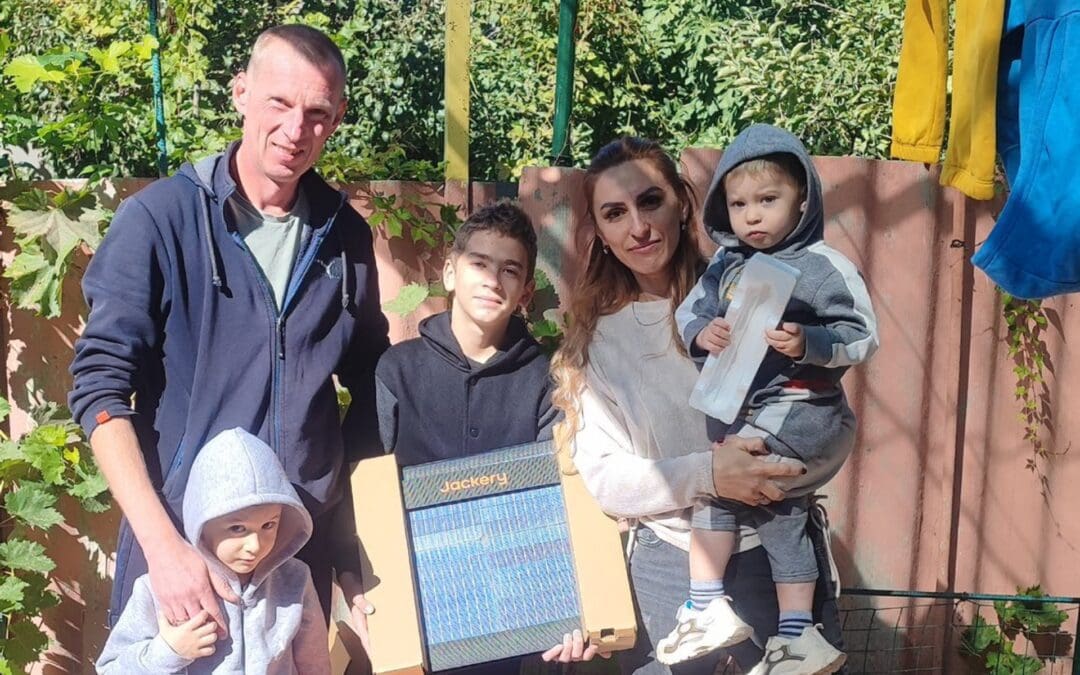
Amid constant blackouts and strategic targeting of energy infrastructure, solar energy solutions are emerging as a crucial tool for resilience. Through the Hope for Ukraine Solar Energy Resilience Program, hundreds of families are now able to reclaim a measure of safety, dignity, and autonomy.
The Energy Crisis in Ukraine: A Humanitarian Emergency
Since Russia’s full-scale invasion in 2022, Ukraine’s energy infrastructure has been under systematic assault. Russian missile, drone, and sabotage attacks have targeted power plants, substations, and high-voltage transmission lines, leaving large portions of the country in darkness.
Today, many regions experience 12–20 hours of power outages per day, and in some areas the average blackout time is 16 hours daily. Hope for Ukraine In frontline zones like Sumy, Dnipro, Zaporizhia, and Kherson, the disruption is even more severe—residents often live with minimal access to essential services like heating, lighting, water, and communications.
For many families, this means resorting to burning firewood indoors for heat and cooking — a practice that not only endangers respiratory health, but also leaves telltale smoke plumes. In a warzone where enemy drones and strike systems may use such visual cues to locate targets, visible smoke becomes a danger signal. Thus, ordinary acts like cooking become tactical liabilities.
In this context, off-grid and stealthy energy sources are no longer a luxury — they are a matter of survival.
Hope for Ukraine’s Solar Energy Resilience Program
Recognizing the urgency of the energy crisis, Hope for Ukraine launched the Solar Energy Resilience Program. This initiative distributes portable Solar Resilience Kits to households in high-risk areas, combining renewable power generation with smoke-free cooking. Through this program, families can power lights, charge phones, run small appliances, and prepare warm meals — all without relying on a fragile or destroyed grid.
What’s in a Solar Resilience Kit?
-
A 200-watt solar panel, compact and deployable in constrained urban spaces
-
A portable power station with multiple sockets
-
A smoke-free electric cooktop for indoor use
-
Charging cables, connectors, and essential wiring
These kits are engineered for practicality. A panel typically takes about eight hours to charge fully, and the stored energy supports a household’s essential electronics and cooking needs. Critically, the electric cooking option emits no smoke, helping families stay under the radar in dangerous zones.
As of early 2025, Hope for Ukraine has distributed 80 kits, with 40 additional units in transit and plans to deliver 200+ more by year’s end. The backlog is stark: over 10,000 families await a kit.
By integrating with existing food aid deliveries and community networks, the program doesn’t just offer hardware — it ensures that donated systems reach those most in need, especially displaced households, women-led homes, rural families, and frontline healthcare workers.
Why Solar Works in Wartime: Benefits & Strategic Advantages
1. Decentralization and Resilience
Centralized power plants and grids are high-value targets in war. In contrast, solar energy systems — especially rooftop or portable systems — are distributed and harder to neutralize. Ukraine is actively pivoting toward decentralized energy systems, including microgrids and community solar, to reduce vulnerability.
By enabling households to generate their own electricity, solar kits bypass grid damage, line failures, and cascading blackouts.
2. Rapid Deployment and Scalability
Solar systems can be installed quickly — especially portable kits like those distributed by Hope for Ukraine — bypassing complex grid repair. Large-scale solar efforts in Ukraine underscore this speed: between 2022–2024, 22 hybrid solar installations (solar + battery storage) were completed across eight regions, benefiting 1.5 million people.
Projects like Renewables for Resilient Ukraine (R2U) have installed solar arrays in hospitals, water utilities, and schools, often in months.
3. Health, Safety & Stealth
Electric cooktops eliminate smoke and flame, reducing indoor air pollution and exposure. This is critical in a conflict zone, where smoke may draw hostile attention.
4. Long-Term Recovery and Energy Independence
These kits are not just stopgap tools—they lay the groundwork for a resilient post-war energy future. Households and communities equipped with renewable energy become less dependent on fragile grids, diesel generators, or foreign fuel imports.
Ukraine’s rooftop PV potential is substantial: one study estimates 238.8 GW of potential capacity across the country, with generation potential reaching 290 TWh annually (excluding north-facing roofs).
Furthermore, high-level efforts are underway: a campaign by Octopus Energy and Ukrainian firm DTEK aims to raise €100 million to build 100 solar + battery projects nationwide. This initiative, called RISE (Resilient Independent Solar Energy), emphasizes decentralized systems as opposed to vulnerable central plants.
Scaling Impact: Solar Beyond Families
While household kits are life-saving, the broader energy transition in Ukraine is also happening at the facility level — schools, hospitals, water utilities, and municipal buildings are increasingly turning to solar.
-
The Energy Act for Ukraine Foundation launched 100SolarSchools and 50SolarHospitals campaigns to install hybrid solar plants across critical infrastructure.
-
Ecoclub’s Solar Aid For Ukraine Project is outfitting hospitals and water utilities with solar power systems and storage to maintain continuous operations during grid outages.
-
Under the Solar Supports Ukraine campaign, SolarPower Europe, ASEU (Ukrainian Solar Energy Association), and BSW (German Solar Association) aim to deploy solar on schools, hospitals, off-grid trailers, and emergency power banks.
The cumulative effect: institutional resilience enables hospitals to treat patients during outages, schools to remain functional, and water systems to pump clean water when main power fails.
Hope For Ukraine Response
At Hope For Ukraine, we are responding to these urgent challenges through programs designed to bring both immediate relief and long-term stability:
-
Mental Health Support: Expanding access to psychosocial services for children and families in distress.
-
Food Assistance: Delivering regular meal kits to displaced and vulnerable families.
-
Shelter Repair & Resilience: Supporting home repairs, providing solar kits, and restoring essential infrastructure.
-
Children’s Programs: Organizing safe camps, events, and activities to give children moments of joy, healing, and normalcy.
Every act of support helps restore dignity and stability to families caught in the middle of war.
How You Can Help
The humanitarian needs in Ukraine are greater than ever — but together, we can make a difference.
-
Donate: Your gift provides food, shelter, and medical aid.
-
Volunteer: Join our mission to deliver direct relief.
-
Spread Awareness: Share our work so others can stand with Ukraine.
Visit our Donation Page to support families today.
Hello,
I am Sudarshan Varadhan, a reporter covering energy for Reuters. I am writing a story on growing interest in distributed solar in Ukraine and am looking to speak to someone who has benefited from your portable Solar Resilience Kits, someone who can speak about others in the neighbourhood who were targets of Russian attacks and how this helped make them safer. Could you please get in touch
+6591164984
sudarshan.varadhan@tr.com