
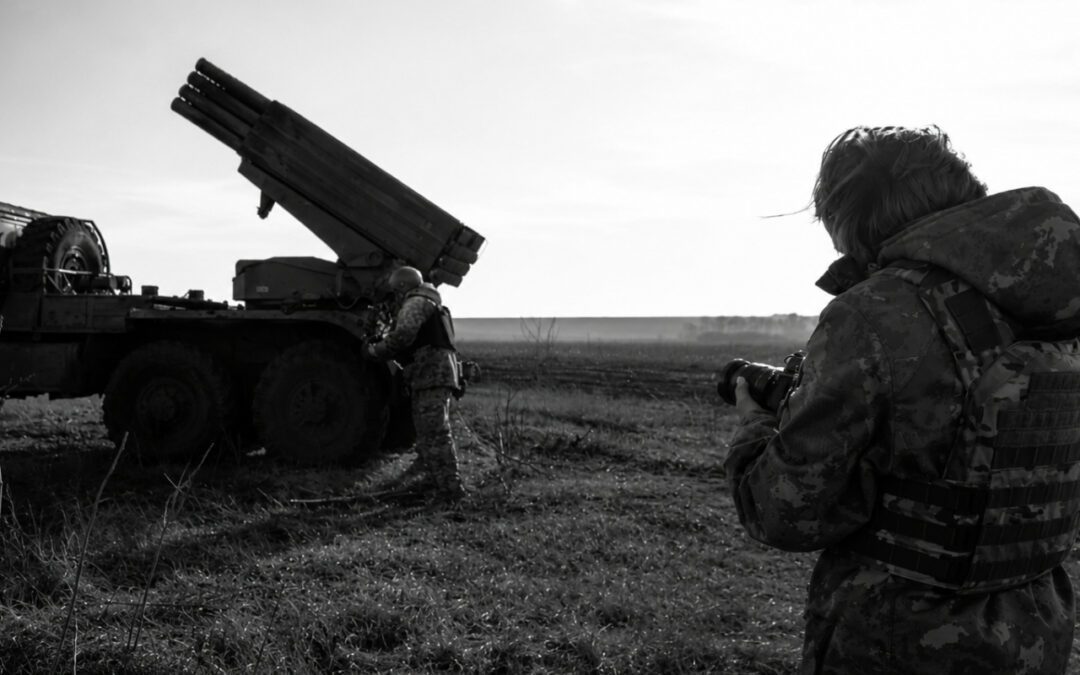
Ukrainian defenders have been holding the line for over four years. As of early 2026, Ukraine has suffered an estimated 55,000 soldiers killed and between 500,000 and 600,000 total military casualties, including the wounded and missing. The men and women in those numbers didn’t choose an easy war. They chose their country. And they’re still out there.
The Cost of War
His call sign is “Botanik.” The nerd. Oleksiy Mykhailov is a biologist by training, a father, and as of April 2026, he had spent 343 consecutive days on the front line in eastern Zaporizhzhia without a single rotation out.
He had the option to leave. He chose not to.
“My company is understaffed,” infantry officer Oleksiy Mykhailov told CNN. “Of those who are here, roughly half are in the 50-plus age bracket. Ideally, an infantryman would spend a month on combat duty and a month recovering. But under current conditions, that’s completely unrealistic.”
Every day, Mykhailov calls his daughter. He misses her beyond words, but he stays to fight. His reason for staying was simple. “I don’t want my family, my daughter, to see what I see — explosions, incoming missiles, destroyed villages, death. That’s why I’m here.”
There are tens of thousands of men and women in similar situations right now, spread across more than 1,200 kilometers of active front line.
The Time Crisis
When a defender gets hit, the clock starts immediately. Traditional hospital networks are nowhere near the contact zone. Stabilization points are often miles away. These are the field units capable of stopping bleeding, restoring basic vital functions, and preparing a soldier for evacuation before he reaches a hospital.
According to battlefield data cited by the Center for European Policy Analysis, a significant portion of Ukrainian military deaths occur not from the initial wound, but from the delay in reaching care.
One combat medic described a single rotation where she evacuated 60 to 70 people in one day. “You arrive, load a couple of people into the vehicle, turn around, and drive off again,” she said. “Sometimes there’s no work, but that doesn’t mean there are no wounded. It only means I can’t go get them because the situation on the ground doesn’t allow it.”
The golden hour principle in battlefield medicine is well established: the faster a wounded person reaches stabilization, the better their odds of survival. On Ukraine’s front, that hour compresses into minutes. The contact line is not a clean perimeter. It’s a moving, contested zone where evacuations under fire are routine and unmanned ground vehicles are now being used to retrieve soldiers stranded at forward positions overnight.
Remembering Ukrainian Defenders: A Day That Belongs to Ukraine
Memorial Day in the United States honors fallen American soldiers. Ukraine has its own equivalent: the Day of Remembrance for Fallen Defenders of Ukraine, observed on August 29.
The date was chosen to mark the culmination of the Battle of Ilovaisk in 2014, when Ukrainian forces were betrayed under a supposed safe corridor agreement. Hundreds were killed. President Zelenskyy signed the decree officially establishing the day of observance in 2019.
The symbol of the day is the sunflower. Fields of them stretch across the eastern Ukrainian landscape where defenders held the line, were wounded, and died.
The front has largely settled into a grinding phase. Territorial advances are measured in hundreds of meters over months. There are no single shock events pulling international attention back the way 2022 did. Russian disinformation is more effective in low-attention environments, and it’s actively working to redirect blame and plant doubt in spaces where Ukraine coverage has gone quiet.
Among soldiers themselves, the feeling is that international support has shifted from dependable to uncertain.
August 29 is twelve weeks away. For those who want to honor Ukrainian defenders on their own terms, that date is worth marking. In the meantime, you can support Hope For Ukraine’s work with defenders right now.
How Hope For Ukraine Supports Defenders and How You Can Help
More than 2,000 attacks on healthcare facilities have been recorded since the full-scale invasion began. Over 250 health workers have been killed. More than 150 attacks have directly affected hospitals serving children and mothers.
What that means on the ground: doctors trying to operate in damaged wards, patients unable to access the surgeries they need, pediatric units running low on supplies.
Hope For Ukraine’s Medical Support Program responds to that directly. Volunteers transport surgical tools, trauma kits, hospital equipment, and critical medications to medical facilities across Ukraine, from emergency care units to pediatric wards. When a hospital can’t get what it needs through official channels, this program fills the gap. When a patient needs urgent surgery and can’t cover the cost, this program helps make it possible.
The work also extends to the front. In partnership with Stabnet, Hope For Ukraine has deployed medical stabilization containers to defenders on the contact line. These are compact, fully equipped units designed to stabilize the wounded before evacuation, in the minutes that determine whether someone survives.
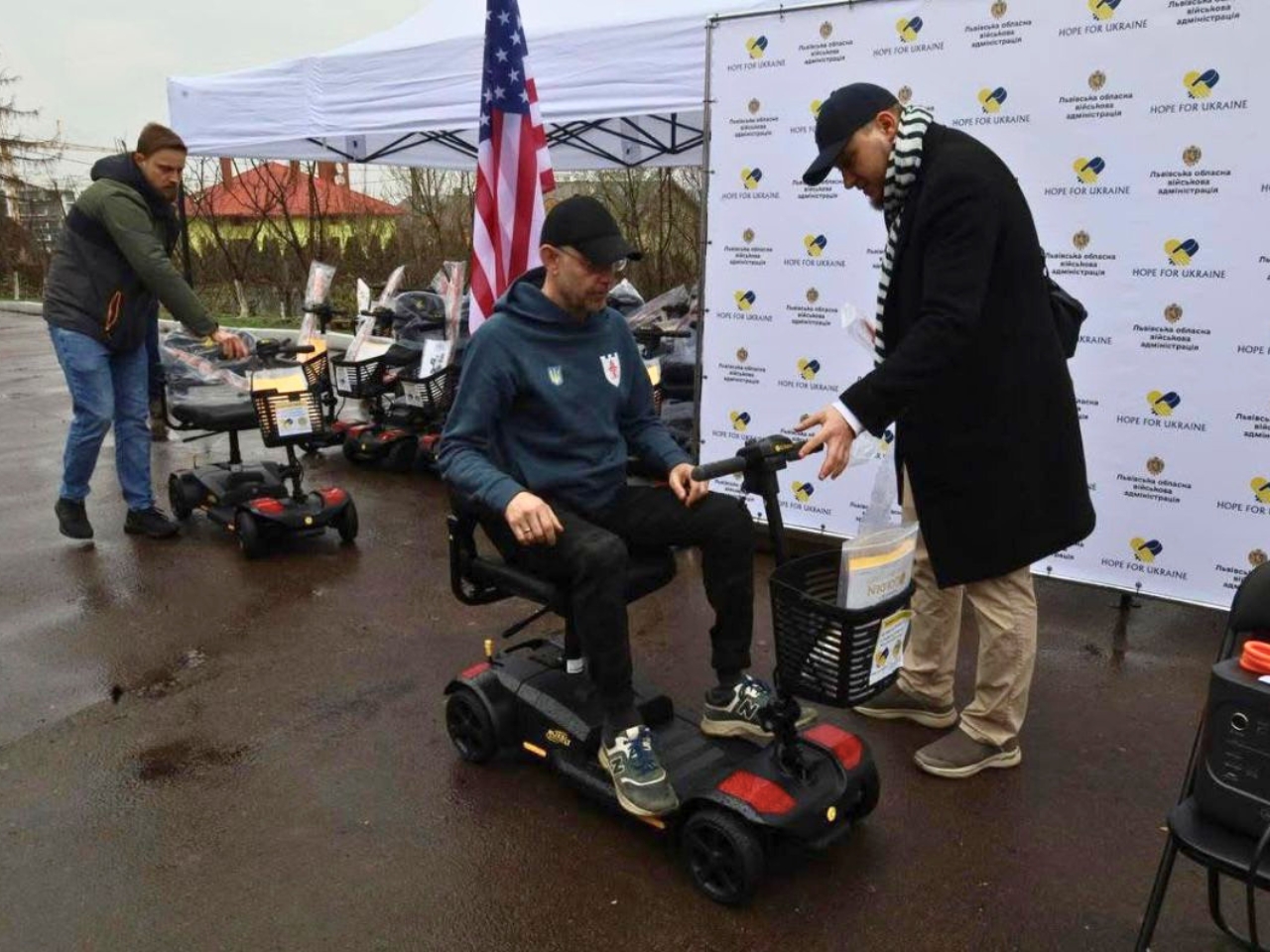
Hope For Ukraine supports veterans with resources such as mobility scooters.To date, HFU has delivered more than 100 mobility scooters to injured defenders, giving them dignity and independence after all they have sacrificed for their country.
Support the Medical Support Program here.
Your gift helps Hope For Ukraine deliver frontline medical aid, stabilization units, essential supplies, and recovery support to Ukrainian defenders and the families behind them. Consider joining the Hope Circle as a monthly donor to make sure that veterans are supported throughout the year.
Frequently Asked Questions
Who are the Ukrainian defenders? Ukrainian defenders are the men and women serving in Ukraine’s armed forces during the ongoing war with Russia. As of early 2026, Ukraine had suffered an estimated 55,000 soldiers killed and between 500,000 and 600,000 total military casualties since the full-scale invasion began in February 2022. Many are volunteers, including soldiers who have served on the front line for months without rotation due to severe manpower shortages.
How does Hope For Ukraine support Ukrainian soldiers? Through its Frontline Support Program and in partnership with Stabnet, Hope For Ukraine delivers mobile stabilization containers to the contact zone, allowing field medics to stabilize wounded soldiers immediately after injury. The organization also delivers first aid kits, food, clothing, hygiene supplies, and emergency aid to frontline positions, as well as motorized scooters to help wounded defenders regain independence during recovery.
What is a mobile stabilization unit? A mobile stabilization container is a compact, fully equipped medical station designed to operate near or at the contact zone of active combat. It allows trained medics to restore vital functions immediately after injury, which is the most critical window for survival. Hope For Ukraine and Stabnet have now deployed more than 11 of these units to defenders on the front line.
What does the Medical Support Program do? The Medical Support Program delivers surgical tools, trauma kits, hospital equipment, medications, and emergency medical supplies to healthcare facilities across Ukraine. Hope For Ukraine volunteers personally transport these materials to hospitals and patients who would otherwise have no access to them, including pediatric wards, emergency units, and frontline communities.
What is Ukraine’s Day of Remembrance for Fallen Defenders? Ukraine observes its Day of Remembrance for Fallen Defenders on August 29. The date marks the end of the Battle of Ilovaisk in 2014, when Ukrainian forces suffered major losses under a broken ceasefire agreement. The sunflower is the symbol of the day, and the Memory Table tradition reserves an empty seat in restaurants across Ukraine for those who did not return.
How can I help Ukrainian defenders right now? You can donate directly to Hope For Ukraine to support mobile stabilization units, frontline medical supplies, family aid, refugee programs, and more. You can also visit the Medical Support Program or Frontline Support Program pages to learn more about each program and direct your gift where it matters most.