
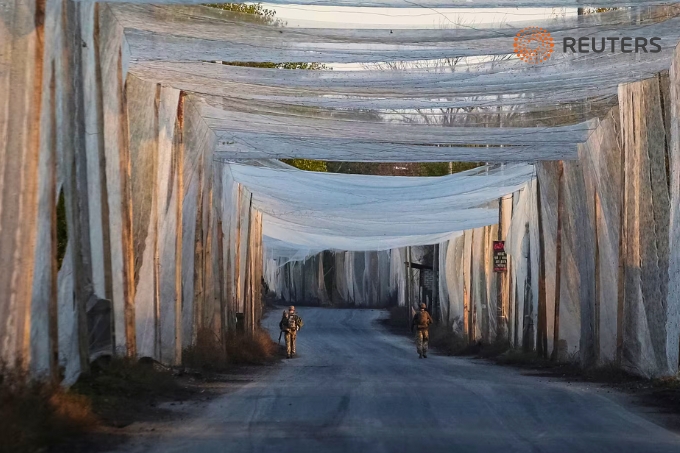
Recent reporting by CBN News offered a rare glimpse into daily life for civilians still living in Kherson, a city where Russian drone attacks have turned ordinary survival into a constant risk. While the world often sees the war in Ukraine through frontlines and military movements, the reality for families trapped in Kherson is quieter and far more personal: how to eat, how to stay warm, and how to remain unseen from the sky.
For those who cannot leave, life is lived under the sound of drones. Nets stretch across courtyards and streets in an attempt to break visual detection, yet residents say it is never enough. Power outages are frequent and prolonged, food is scarce, and even stepping outside a home can be fatal. Entire neighborhoods have become red zones where public services no longer operate and where humanitarian access is limited by constant danger.
This is where teams from Hope For Ukraine continue to operate. Week after week, volunteers make long, exhausting journeys into the region, fully aware that each trip carries risk. Their purpose is simple but urgent: to reach families who have been cut off from basic necessities and who would not survive without outside help.
Aid delivered into Kherson is carefully adapted to the conditions civilians face. Food kits are designed to sustain families for days at a time, reducing the need to move or search for supplies. Solar power units and cooktops allow families to prepare meals and maintain basic electricity without producing smoke or light that could draw attention from the air. In a city where infrastructure has been repeatedly targeted, these tools are not conveniences—they are safeguards.
Many of the volunteers involved in these missions are Ukrainian believers who have been serving displaced families since the earliest stages of the conflict, long before the full-scale invasion. Their work is driven not by visibility or recognition, but by a commitment to stand with people who have been largely abandoned due to danger. As Hope For Ukraine CEO Yuriy Boyechko has explained, the focus at the frontline is on sustaining life quietly and consistently, even when conditions make every visit uncertain.
The contrast between Kherson today and just a few years ago is stark. After the city was liberated from Russian occupation, public squares were filled with celebration and hope. Today, those same spaces are marked by memorials, photographs, and flags honoring those who have died. Even government buildings have not been spared, and aid teams limit their time on the ground to reduce exposure to drone attacks.
For residents who remain, the presence of humanitarian aid is more than material support. It is a reminder that they have not been forgotten. Families speak of long stretches without electricity, of cold nights and empty shelves, and of fear that has become routine. Against that backdrop, each delivery of food or solar equipment represents stability in an otherwise unpredictable environment.
Hope For Ukraine’s work in Kherson is not about dramatic moments or headlines. It is about persistence. It is about showing up repeatedly, even when access is dangerous and progress is measured in small victories. While reports of drone attacks and civilian targeting continue to surface, the organization’s teams remain committed to returning each week, standing alongside those who cannot flee, and providing the essentials that keep communities alive.
As the war grinds on and conditions in places like Kherson remain dire, humanitarian efforts like these form the thin line between survival and collapse. Behind every aid run is a quiet act of resistance against despair—a belief that even in the most dangerous places, compassion and action still matter.