
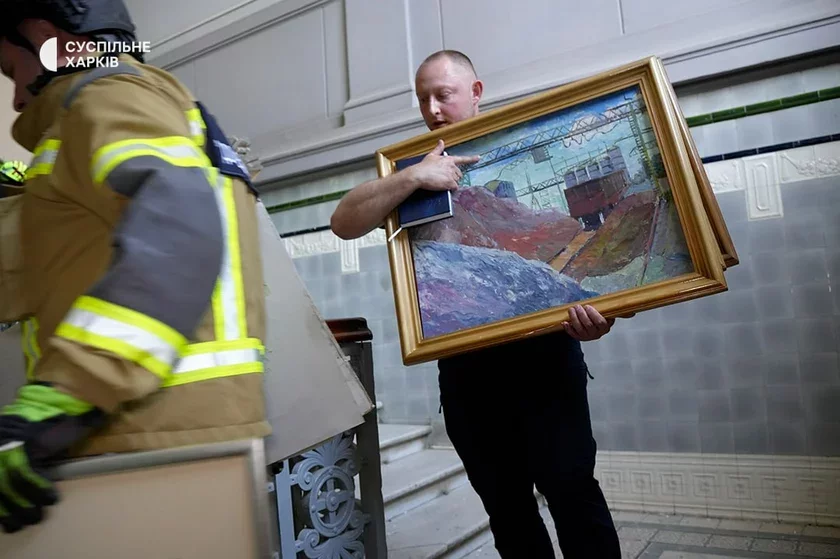
On the evening of June 14, 2026, a Russian drone hit the Kharkiv Art Museum. Emergency responders, museum staff, and Kharkiv Mayor Ihor Terekhov formed a line through the building, carrying paintings down the staircases and out into the street to keep them from the fire. Journalists who had come to cover the attack set down their cameras and joined the chain. Passersby stopped and helped pass artwork hand to hand. Nobody gave an order. Nobody coordinated it. They looked at what was burning and knew it was worth saving.
That same night, Russia launched one of its largest combined strikes of the war. More than 60 missiles and hundreds of drones hit Kyiv, killing at least five people and setting fire to the Kyiv Pechersk Lavra, an 11th-century monastery and UNESCO World Heritage site at the heart of the city. Hours earlier, a strike on the Oleksandr Dovzhenko National Film Studio destroyed Ukraine’s largest and oldest costume collection: around 100,000 costumes and three million items of clothing, including pieces from celebrated Ukrainian films built across nearly a century of filmmaking.
Ukraine’s cultural heritage destruction is not a side effect of this war. Across four years of full-scale invasion, UNESCO has verified damage to 515 cultural sites since February 2022, including 153 religious sites, 38 museums, and 268 buildings of historical and artistic importance. The pattern is clear. Russia is attempting to destroy Ukraine’s cultural heritage.
The Kharkiv Art Museum holds about 25,000 works, including paintings, graphics, sculpture, and decorative arts spanning the 15th through 21st centuries. For a city that has absorbed repeated strikes because of its location near the Russian border, losing the museum was about more than art. It was about memory. About the particular weight of an institution that survived war before, only to find itself on fire again.
Kharkiv regional governor Oleh Syniehubov called the attack “another act of Russian terrorism,” framing it as a direct hit on civilians and heritage rather than collateral damage from battlefield activity. Six people were injured in the strike, including a one-month-old infant.
In Kyiv, the Dormition Cathedral at the Kyiv Pechersk Lavra took a direct drone strike, causing extensive damage to the roof structure. A fire broke out inside the main church. Religious artifacts, historic icons, and sacred items were urgently evacuated. The blaze covered approximately 800 square meters before firefighters contained it.
At the Dovzhenko Studio, director general Andriy Donchyk said the costume workshop took a direct missile hit with nothing left to save. “It is impossible to assess these losses,” he said. “These are unique costumes that we periodically exhibited in the museum, and we dreamed of staging a grand costume parade for the film studio’s centenary.”
Three institutions that held pieces of what Ukraine is, gone in a single night.
There is a tendency to treat attacks on museums and churches as softer losses compared to civilian casualties. They are not. By February 2026, Ukrainian authorities reported that roughly seven million cultural artifacts had been lost, with 1.7 million stranded in temporarily occupied territories. More than five million archival documents from Ukraine’s National Archival Fund had fallen under occupation since 2014.
When the costumes from Shadows of Forgotten Ancestors burn, threads woven by hand to tell Ukraine’s oldest stories turn to ash. When the Kyiv-Pechersk Lavra is shelled, the fire eats through timber and brick that have anchored Ukrainian faith for nearly a thousand years—a place where generations have wept, buried their dead, and known exactly who they were. And when a missile strikes a regional museum, 15th-century canvases blister, blacken, and dissolve into smoke. These aren’t just properties on a map; they are the physical receipts of a nation’s soul, and once they are gone, no one can wish them back.
What Russia cannot steal, it burns. What it cannot burn, it buries. This is a deliberate effort to sever Ukraine from its own story.
Taras Voznyak, director of the Lviv National Art Gallery, said it plainly: “Putin knows that without art, without our history, Ukraine will have a weaker identity.”
The attacks on June 14 and 15 did not happen in isolation. They came on top of four years of sustained bombardment that has displaced millions, destroyed civilian infrastructure, and forced families to rebuild their daily lives around uncertainty and loss.
Help preserve the Ukrainian culture. Donate to provide life-sustaining essential aid at hfu.org/donate.