
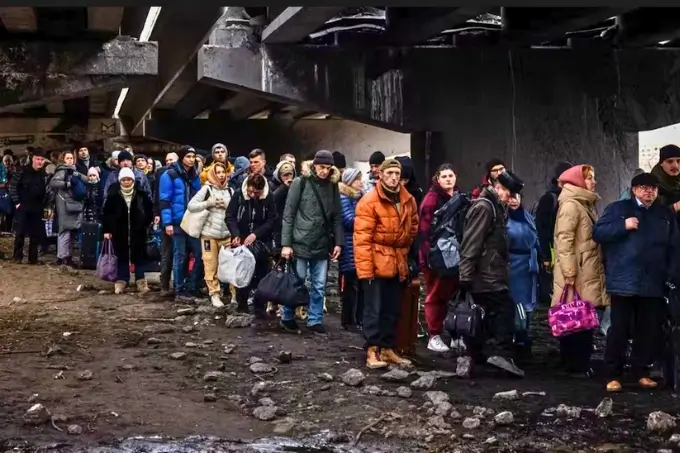
In one of the most alarming developments of the war, newly released data from Ukraine’s Coordination Headquarters reveals that 46,327 Ukrainian civilians have been forcibly mobilized by Russia in occupied territories. This practice—explicitly prohibited under the Fourth Geneva Convention—amounts to a systematic war crime. Yet despite its scale, Russia’s forced mobilization of Ukrainians remains one of the least-reported humanitarian crises of the conflict.
These civilians are not trained soldiers. They are teachers, laborers, students, and parents—many seized from their homes or workplaces and coerced into joining Russia’s military structure. Reports indicate that many are sent directly to the front lines with minimal training, effectively used as expendable manpower in high-risk assault operations. According to Ukrainian intelligence, one in every six captured “Russian soldiers” is actually a Ukrainian forced to fight against his own country.
The scale and brutality of this practice reveal a deeper strategic intent: a campaign of demographic cleansing designed to weaken Ukrainian identity in occupied regions. “These individuals are being kidnapped, coerced, and turned into cannon fodder,” says Yuriy Boyechko, CEO of the humanitarian organization Hope For Ukraine, which maintains one of the largest civilian support networks inside the country. Boyechko warns that families of forcibly mobilized civilians are reaching out in desperation, seeking answers, legal help, and any information about loved ones who disappear after being taken by Russian occupation authorities.
This often-ignored dimension of the conflict represents not just a violation of international law, but a profound humanitarian emergency. It exposes a grim reality: in many occupied regions, Ukrainians are living under a coercive apparatus that seeks to erase resistance by removing able-bodied men and sending them to the battlefield under a foreign flag.
The Sanctions Debate: Will New U.S. Measures Change Anything?
At the same time, U.S. policymakers are pursuing a different front in the struggle for Ukraine’s survival. A newly announced Republican-backed bill—endorsed by former President Donald Trump—promises “very severe” secondary sanctions against any country continuing to trade with Russia. The legislation reportedly includes the authority to enforce tariffs as high as 500%, a move unprecedented in scope.
While the political symbolism is striking, experts question whether the bill—as written—can meaningfully change behavior on the ground. Yuriy Boyechko cautions that unless Washington is prepared to rigorously enforce these measures, the impact will be limited. “Sanctions look powerful on paper, but without consistent enforcement, they rarely disrupt the machinery that enables forced mobilization, weapons production, and occupation,” he notes.
Past patterns offer sobering context. Even under broad sanctions, Russia has repeatedly adapted through:
-
Trade diversion via China, India, and Middle Eastern intermediaries
-
The growth of a massive shadow fleet transporting Russian oil
-
Complex supply-chain laundering that disguises the origin of goods
-
Legal “workarounds” used by companies unwilling to lose access to Russian markets
These strategies weaken the intended effect of sanctions while increasing global prices and destabilizing supply chains. The question, analysts say, is not whether the U.S. can impose extreme penalties—but whether it’s prepared to override its own political and economic interests to enforce them fully.
Historically, even administrations that loudly champion sanctions have hesitated when enforcement risks blowback from major trade partners or domestic industries. The Trump administration itself faced criticism for inconsistent sanctions enforcement against Russia, with several measures delayed, softened, or only partially implemented.
If this pattern continues, the new tariff-heavy regime risks becoming a symbolic statement rather than a meaningful deterrent. Without a dramatic shift in political will, Russia’s forced mobilization of Ukrainians will continue largely unchecked, while the global economy absorbs the shock of escalating restrictions.
A Call for International Attention
The forced mobilization crisis demands far more global attention than it is currently receiving. Families in occupied territories live with the constant threat that their sons, husbands, and brothers could be taken at any time. These civilians have no recourse to appeal, no legal protections, and no ability to refuse.
Hope For Ukraine’s extensive on-the-ground network offers humanitarian support, legal guidance, and emergency aid through programs including:
The organization remains one of the few U.S.-based groups actively documenting testimonies from families affected by forced mobilization.
“We are prepared to share firsthand accounts, data, and the lived experiences of those facing this nightmare daily,” Boyechko says. “The world cannot allow this practice to continue in silence.”
As winter intensifies and Russia tightens control over occupied regions, the need for global visibility, pressure, and humanitarian support has never been more urgent.