
As Russia’s campaign against Ukraine’s energy grid intensifies this winter, much of the public discussion continues to center on “repairs” and “restoration.” For millions of Ukrainians, however, that framing no longer reflects reality. Nearly nine million people now live below the poverty line, and for them, the power grid may never fully recover. The standard backup solution—a gas generator costing roughly $800, plus ongoing fuel expenses—is financially impossible for families already struggling to meet basic needs. This growing gap has turned energy access into a matter of inequality. While some households can insulate themselves from blackouts, others are left in darkness, unable to refrigerate food, power medical devices, or charge a phone to contact loved ones. For elderly residents and displaced families, the absence of reliable electricity is not an inconvenience but a daily threat to dignity and safety.
At Hope For Ukraine, this reality has driven a major shift in humanitarian strategy. Rather than treating blackouts as a temporary emergency, the organization is launching an ambitious five-year initiative to provide one million impoverished families with Solar Energy Resilience Kits, creating decentralized, personal power systems that function independently of the national grid. The goal reflects a recognition that Ukraine’s energy crisis is no longer short-term—and that waiting for centralized restoration will leave the most vulnerable behind. Energy analysts increasingly warn that much of Ukraine’s centralized power generation may take a decade or more to fully recover, even if the war were to end today. Repeated strikes, aging infrastructure, and limited resources have permanently altered the country’s energy landscape. As a result, humanitarian aid is evolving from emergency stopgaps toward long-term survival solutions that acknowledge this new normal.
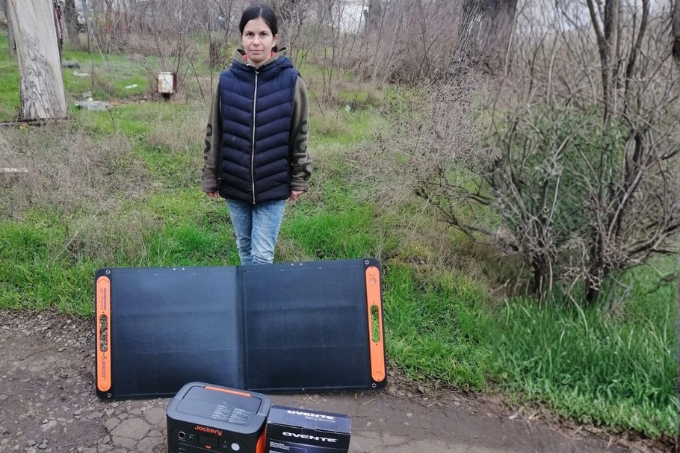
Solar technology has emerged as one of the few tools capable of meeting that challenge at scale. Unlike fuel-dependent generators, Hope For Ukraine’s Solar Energy Resilience Kits provide silent, renewable power through portable solar stations and panels. They allow families to power lights, charge phones, run essential medical equipment, and regain a sense of stability without relying on scarce fuel or fragile infrastructure. For many recipients, the kits represent the return of what they describe as the “dignity of light.” Hope For Ukraine has already surpassed its 2025 targets, delivering more than 1,000 solar kits to frontline families in regions such as Kherson and Kharkiv. Now, the organization is scaling that effort dramatically, aiming to reach one million families over the next five years. It is an audacious goal, but one that aligns with the scale of the crisis, especially as roughly half of Ukraine’s energy generation capacity remains offline.
In frontline “gray zones,” decentralized solar power is quickly becoming a primary survival tool rather than a backup option. Elderly residents and displaced Ukrainians are using these systems to stay connected, maintain basic health needs, and endure prolonged outages with greater safety and autonomy. As winter deepens, the shift toward decentralized energy is no longer experimental—it is essential. Hope For Ukraine continues to expand this work across Ukraine, pairing immediate humanitarian relief with long-term resilience strategies that acknowledge the realities on the ground. More information about the organization’s energy resilience initiatives and ongoing humanitarian programs can be found at https://hfu.org and through its donation platform at https://donate.hfu.org, where supporters are helping bring sustainable power to families who would otherwise be left in the dark.