
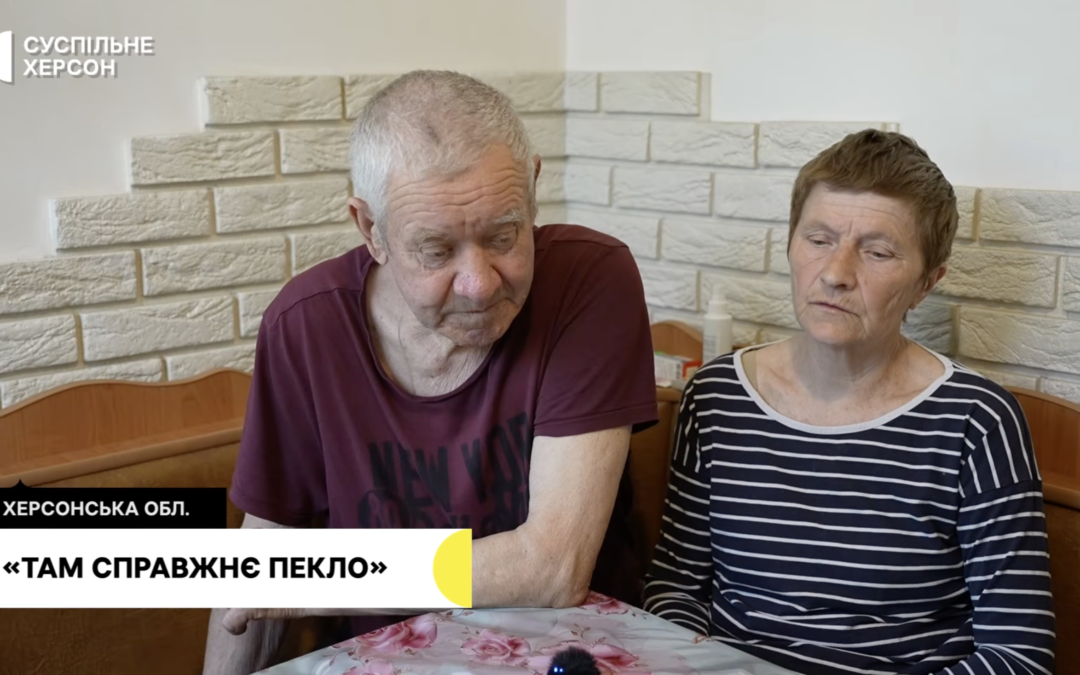
Valeriy Marecki’s maroon t-shirt hangs off his frame like a borrowed garment. He speaks slowly, hunched over a table, his deeply lined face carrying the weight of a survival he is still struggling to process.
“I was 106 kilograms,” he told the Ukrainian public broadcaster Suspilne Kherson. “Now I am 76. Thirty kilograms — without any diet.”
Beside him, his wife Natalia nods. “I am 48 kilograms,” she adds quietly, her collarbones visible beneath her shirt.
They are surrounded now by their daughter and grandchildren, safe inside a cramped room with a boarded-up window. But their bodies tell the story their words can barely contain.
The Mareckis escaped from Oleshky, a city of roughly 24,000 people before the war on the eastern bank of the Dnipro River in Ukraine’s Kherson region.
Since Russia’s full-scale invasion began in 2022, Oleshky has been under occupation. It survived the catastrophic flooding that followed the destruction of the Kakhovka Dam in June 2023 — a disaster that submerged much of the city and displaced thousands.
Since December 2025, however, it has been dying a slower death: a complete blockade with no electricity, no gas, no running water, no medicine, and increasingly, no food.
An estimated 1,700 to 2,000 civilians remain trapped inside — a fraction of the city’s prewar population, but still a city’s worth of human suffering.
Most are elderly residents who could not or would not leave when evacuation was still possible. The roads out are heavily mined. Russian drones patrol the main evacuation route, which locals have taken to calling “the road of death.”
In the first weeks of February alone, roughly six civilian cars attempting to bring food into the city were destroyed by mines or drone strikes, according to Ukrainian regional authorities.
As spring turns to summer, conditions have only worsened: whatever reserves civilians managed to hold through winter are now exhausted. Aid organizations cannot get in. People cannot get out.
Valeriy and Natalia Marecki, whose story was first reported by Suspilne Kherson, described their escape as a desperate gamble.
After finding primary routes sealed or actively bombed — a group that tried on the 16th was struck — the couple ultimately navigated a circuitous, unmarked path through occupied territory, a high-stakes flight Valeriy called, with bleak irony, “the circle of honor.”
His blood sugar spiked dangerously upon arrival. He is still recovering. Most people still inside Oleshky have no such route available to them.
For those who remain, the situation has become something medieval in its cruelty.
Stores have been closed for months. Ukrainian officials and survivor testimonies describe Russian soldiers — themselves reportedly running short on supplies — conducting forced entries into civilian homes and basements to seize whatever food remains.
Those who resist have been killed. Local authorities have documented multiple such cases, though independent verification is impossible given the near-total communications blackout.
What filters out comes in fragments: a phone call, a survivor’s account, a message passed hand to hand across the front line.
Ukrainian officials and human rights advocates assert that this is not an accidental consequence of combat.
Russian forces, they argue, are deliberately weaponizing the remaining population — including an estimated 47 children — as human shields to deter Ukrainian counter-attacks.
The logic is as calculated as it is monstrous: a city full of civilians is harder to strike. Trapping a civilian population to protect military positions is a war crime under the Fourth Geneva Convention.
Deliberately starving civilians as a method of warfare is prohibited under Additional Protocol I. Both are occurring in Oleshky, in plain sight, with no meaningful international response.
Ukraine’s Foreign Ministry has issued urgent appeals, calling on international partners to pressure Russia into adhering to basic humanitarian law.
The International Committee of the Red Cross has expressed readiness to assist but cannot act without a guaranteed humanitarian corridor — which Russia has not provided.
There are reports that the city’s morgue is overwhelmed. There are reports of bodies left in the street.
Meanwhile, Western attention has drifted — toward other conflicts, toward election cycles, toward the exhausting arithmetic of a war now in its fifth year.
Oleshky has become what diplomats call a frozen situation, which is another way of saying that people are dying and the world has decided it can live with that.
That must change.
Western governments must use every available lever: targeted sanctions on the commanders and officials responsible for administering this siege; coordinated diplomatic pressure on Moscow; and a formal, public demand that Russia permit the ICRC unfettered access to the left bank of the Dnipro.
The European Union and the United States have repeatedly conditioned their policy on Russia’s conduct in this war.
The siege of Oleshky — its architects, its enforcers, its daily casualties — must become a specific, named condition in those negotiations, not a footnote.
International criminal accountability matters here too.
The Office of the Prosecutor at the International Criminal Court has already issued arrest warrants related to this conflict.
The siege of Oleshky — the deliberate starvation of civilians, the use of human shields, the documented killings of residents protecting their own food — warrants investigation as a potential crime against humanity.
Documentation efforts by Ukrainian authorities, independent journalists, and NGOs must be supported and resourced now, while witnesses can still speak and evidence can still be gathered.
Valeriy, still visibly frail, managed a faint smile when asked how he felt to be out.
“The main thing,” he said, “is that we are home. That the soul is at peace. That we are with our children.”
For the thousands still inside, that peace is not a possibility.
They are trapped, hungry, and disappearing from the world’s attention. There is a specific policy vocabulary for this moment: humanitarian corridor, targeted sanctions, ICC referral, international monitoring.
What is needed now is the will to use it.
Yuriy Boyechko is the founder and chief executive of Hope For Ukraine.