
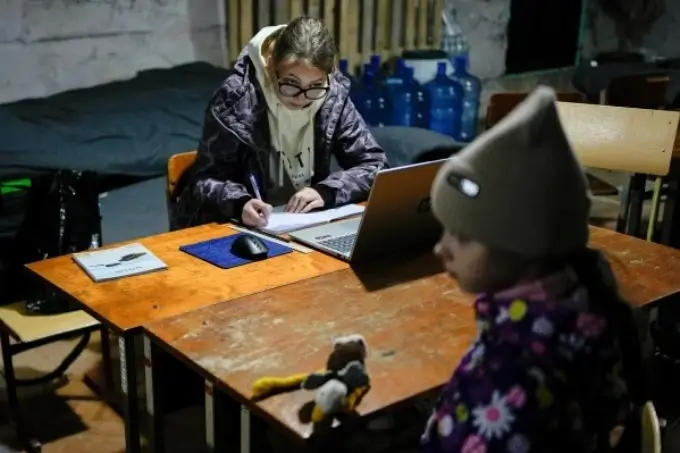
Ukraine is entering one of the most dangerous phases of the war yet—an escalating, long-term power crisis triggered by recent Russian strikes that have severely damaged the country’s energy grid. For millions of families, the immediate future now includes 8 to 12 hours of daily blackouts, a grim routine expected to continue for weeks and possibly months. As winter approaches, this development marks a turning point in the humanitarian emergency unfolding across the country.
According to Ukrainian energy officials, the attacks were not just disruptive—they were structurally devastating, targeting generation facilities that cannot be quickly restored. The Tripilska (Trypilska) Thermal Power Plant near Kyiv, one of Ukraine’s most important electricity generators, is now reportedly non-operational. The Zmiivska (Zmiivs’ka) plant in the Kharkiv region has sustained similar damage. Both facilities played a critical role in powering major cities and stabilizing the grid during past waves of attacks.
Because of these losses, energy authorities warn that Ukrainians should expect an extended schedule of outages that will “reset” the country’s daily life. The current expectation is 8–12 hours without power every day, with even the most optimistic forecasts projecting a difficult “improvement” to 8-hour cuts, and eventually 4-hour cuts, over a timeline of months—not days.
These long-term disruptions are especially dangerous because they affect not only electricity, but also heating systems, water pumps, communication networks, schools, hospitals, and food storage. With the war entering its fourth winter, and temperatures dropping, this sustained attack on generation capacity is likely to trigger cascading humanitarian needs that demand urgent global attention.
A Systemic Crisis, Not a Temporary Disruption
While Ukraine has endured years of Russian strikes on its infrastructure, energy experts and government officials are sounding the alarm that this wave is different. The targeting was strategic and designed to damage systems that cannot be easily repaired. The destruction of generation capacity—not just transmission lines—means that even if wires and substations are fixed, the grid simply doesn’t have enough electricity to distribute.
This is why the daily outages are scheduled, predictable, and unavoidable.
Ukrainian officials have described the situation as one of the worst energy crises since the full-scale invasion began. Power companies have already warned residents to brace for weeks of systemic shortages. Emergency imports from Europe may relieve some pressure, but they will not replace the lost capacity in the near term.
The risk extends beyond homes and neighborhoods. Factories, schools, farms, and humanitarian distribution points depend on reliable electricity to function. When the power goes out for 8–12 hours each day, entire regions come to a standstill.
Implications for Civilians: A Winter of Hardship and Displacement
The humanitarian consequences of this energy collapse are profound. Millions of Ukrainians now face:
-
Cold apartments and homes with no heat
-
Limited water access where pumps rely on electricity
-
Loss of communication when routers and cell towers shut down
-
Inability to refrigerate food or medications
-
Dark, unsafe streets and stairwells
-
Interrupted schooling for children, especially online classes
-
Hospitals running on backup generators
For vulnerable populations—elderly residents, families with young children, and people living near the frontlines—these conditions are life-threatening.
Humanitarian organizations are warning that prolonged cold and darkness could lead to increased displacement, with families leaving their homes in search of safe, predictable power. A new wave of migration—internal and cross-border—remains a real possibility if outages persist through the winter months.
Hope For Ukraine Responds: Solar Kits, Food Relief, and Emergency Support
Hope For Ukraine (HFU), under the leadership of Yuriy Boyechko, has been preparing for a scenario exactly like this. For the past year, HFU’s Solar Energy Resilience Program has delivered hundreds of portable solar systems to families living in blackout-affected regions. These kits provide 8+ hours of safe daily power, giving households the ability to light their homes, charge phones, run small appliances, and stay connected during outages.
As news of the long-term blackout schedule spreads, HFU is rapidly scaling the program. A major shipment of solar generators is already en route from New Jersey, pushing the initiative toward its milestone of 1,000 solar energy kits delivered in its first year.
Alongside energy support, HFU continues distributing food, water, and winter supplies, ensuring families have the essentials needed to endure both the cold and the power cuts.
Boyechko emphasizes that “every solar kit, every food package, every warm meal is now a critical lifeline. With daily blackouts becoming the norm, our work has never been more urgent or more necessary.”
A Global Story With Global Implications
This crisis is not only about Ukraine’s survival—it is a case study in how modern warfare targets energy systems to destabilize entire nations. The destruction of Tripilska and Zmiivska shows how vulnerable power grids are in conflict zones, and how quickly civilian life can collapse without electricity.
As winter intensifies, international support is essential. HFU is calling on donors, media organizations, and humanitarian partners to help raise awareness and mobilize resources. The world must understand: Ukraine’s power crisis is not temporary—it’s long-term, systemic, and dangerous.
Hope For Ukraine will continue to stand with families through the darkest months of the year, bringing food, warmth, light, and hope wherever it is needed most.