
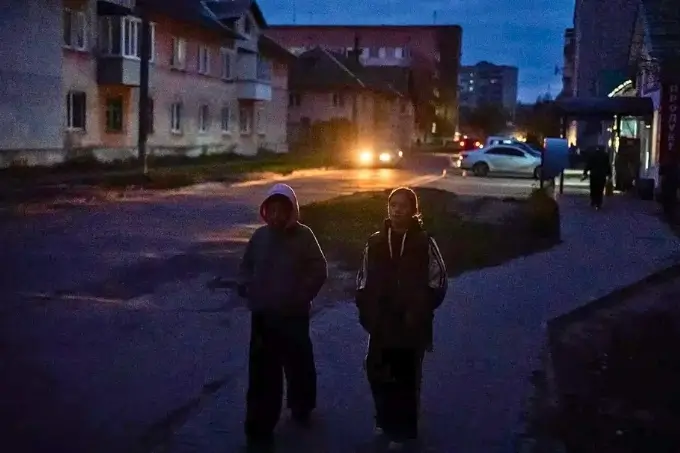
As winter descends, Ukraine’s winter crisis has reached a pivotal moment—one defined by the convergence of three national emergencies. The country is now fighting three simultaneous wars: a brutal military struggle against Russian forces, a rapidly deepening energy collapse, and a destabilizing internal battle against corruption that threatens Ukraine’s democratic trajectory.
This is not simply another winter of hardship. It is a defining crossroads that will determine whether Ukraine can survive as both a functioning state and a trusted partner to the West.
A Power Grid Under Assault—and a Nation at Risk
Russian missile and drone attacks have methodically targeted Ukraine’s critical infrastructure, striking power plants, transmission lines, and substations across the country. These attacks have plunged millions into rolling or prolonged blackouts, creating a humanitarian emergency that grows more severe by the day.
With temperatures dropping, the consequences are sweeping:
-
Hospitals and water systems struggle to maintain operations
-
Schools and shelters fight to stay heated
-
Military logistics and industrial capacity slow due to unstable power
-
Families are forced to navigate long hours without electricity
This effort to dismantle the grid is no accident. It is part of a calculated strategy to weaponize winter and break civilian resilience.
Learn more about Hope For Ukraine’s humanitarian priorities at hfu.org.
A Frontline Stretched Thin
While civilians brace against darkness and cold, Ukrainian soldiers face their own escalating crisis. The frontline—spanning hundreds of miles—has become a punishing zone of attrition, where Russian forces expand their offensive operations and force Ukraine into intense close-quarters battle.
Key pressures include:
-
A longer frontline that strains manpower and supply routes
-
Limited opportunities for troop rotation
-
A larger, better-equipped adversary with growing mobilization capacity
-
Severe operational challenges tied to the energy grid collapse
Ukraine’s defense forces are fighting under increasingly austere, physically exhausting conditions—conditions worsened by the very outages now sweeping the country.
The Corruption Scandal Undermining National Security
The most volatile challenge, however, comes from within.
Ukraine is now confronting a $100 million corruption scandal involving individuals with ties to government and the state nuclear operator, Energoatom. Funds intended to reinforce the national energy grid were allegedly siphoned away—directly contributing to vulnerabilities now being targeted by Russia.
This is not merely a governance problem.
It is a national security crisis.
Corruption in this context becomes more than misconduct—it becomes an unintentional ally of Russian aggression, deepening public anger and raising serious concerns among Western allies evaluating Ukraine’s future EU integration and ongoing aid packages.
It is here that Ukraine’s winter crisis becomes more than a story of cold and conflict—it becomes a question of democratic resilience.
Read about HFU’s mission and values: https://hfu.org/who-we-are/mission/.
The Most Critical Untold Story of the Winter
The intersection of the military, humanitarian, and political crises creates an unprecedented inflection point. The stakes are enormous:
-
Will Ukraine maintain stability during months of severe blackout conditions?
-
Can leaders demonstrate integrity at a moment when Western trust is essential?
-
Will the nation’s armed forces withstand simultaneous environmental and tactical pressure?
The decisions made in these winter months will shape Ukraine long after the war ends.
A Voice From the Ground: Yuriy Boyechko of Hope For Ukraine
Few individuals understand the depth of this crisis more clearly than Yuriy Boyechko, CEO of Hope For Ukraine, one of the largest humanitarian organizations operating inside the country. HFU delivers food, medical care, generators, clothing, shelter assistance, and power solutions to families across Ukraine—including in frontline towns and hard-hit regions.
Learn more about Yuriy Boyechko’s leadership:
👉 https://hfu.org/who-we-are/leadership/
“Our teams see the reality every day,” Boyechko says. “Ukraine is fighting three wars at the same time. A military war, an energy war, and an internal war against corruption. Each one affects the others. Together, they define whether the country survives the winter.”
Boyechko emphasizes that this story is not receiving the national attention it requires:
“The grid, the military pressure, and the corruption scandal are interconnected. If any one of them spirals out of control, the impact will be devastating. The world needs to understand how fragile this moment truly is.”
He welcomes deeper discussion and is available to provide press insights on the humanitarian and national implications of these converging crises.
Solar Energy Resilience: A Lifeline for Families in Darkness
As power outages grow more frequent, Hope For Ukraine is expanding its Solar Energy Resilience Program, delivering solar-based power kits to families living without stable electricity. These systems allow households to keep lights on, charge essential devices, power small heaters, and maintain communication during extended blackouts.
Learn about the program here:
👉 https://hfu.org/how-to-help/solar-energy-resilience-program/
These solutions are becoming a lifeline for families in frontline and liberated regions—offering safety, warmth, and dignity when the grid fails.
Standing With Ukraine When It Matters Most
Hope For Ukraine remains committed to delivering food, heat, medical resources, and energy solutions to the most vulnerable communities throughout the hardest winter of the war. But as the country confronts a battlefield, an energy collapse, and internal instability at the same time, the need for global understanding—and global support—has never been greater.
Ukraine’s future will be determined not only by the battles fought at the front, but by the unity, accountability, and resilience shown in these defining months.