
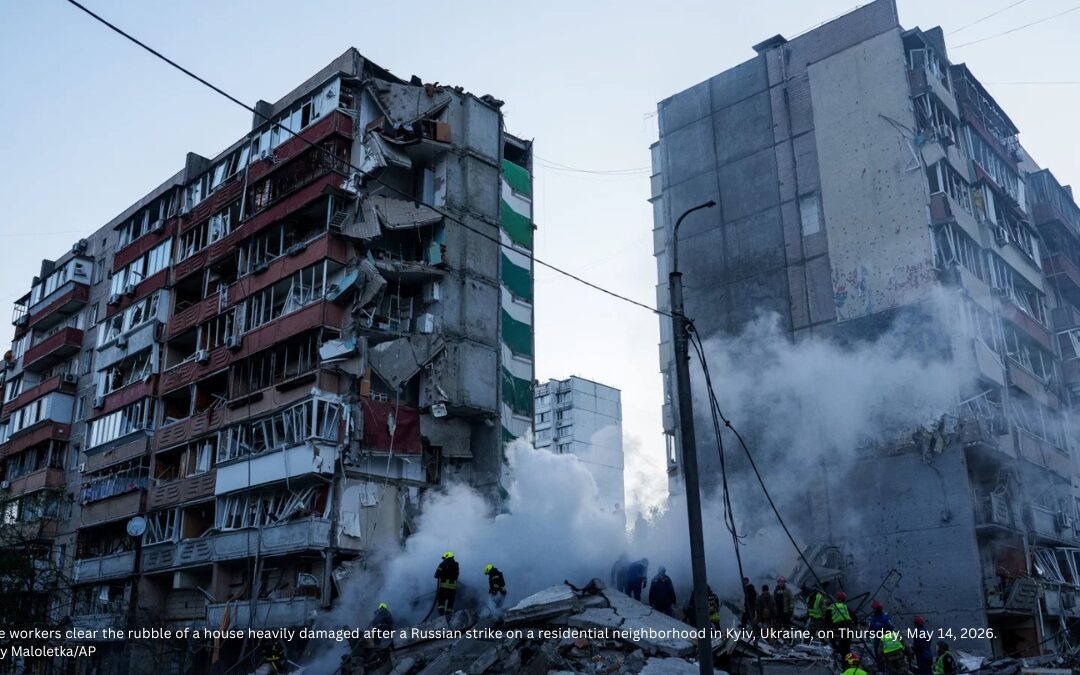
What is happening in Ukraine right now is not a story that’s winding down. On the night of May 14, 2026, a Russian missile struck a nine-story apartment building in Kyiv. Twenty-four people were killed. Among them were three girls: ages 12, 15, and 17. That moment tells you more than any statistic can.
The war is in its fifth year, and the humanitarian situation is getting worse, not better. More civilians were killed in April 2026 than in any month since July 2025. Attacks on cities, hospitals, and aid convoys continue. And 10.8 million people still need humanitarian assistance just to get through the year.
This post breaks down the current situation clearly, based on data from the UN, UNICEF, UNHCR, and OCHA as of May 2026.
What Is Happening in Ukraine Right Now: The Escalating Attacks
It’s easy to assume a war in its fifth year must be slowing down. The opposite is true.
Between May 13 and 14 alone, Russia launched more than 1,500 drones and dozens of missiles at cities across Ukraine. The Kyiv apartment strike was the deadliest single incident, but it wasn’t isolated. According to UN News, the attack killed 24 people and injured at least 48 others.
UN officials who addressed the Security Council on May 19 warned that the war is “becoming deadlier by the day.” Short-range drones now account for more civilian deaths per month than at any point since the invasion began in February 2022. These weapons are cheap, fast, and nearly impossible to defend against in populated neighborhoods.
In April 2026, at least 238 civilians were killed and 1,404 were injured, the highest monthly casualty count in nearly a year. As of April 2026, the UN has verified 60,659 civilian casualties since the start of the invasion. Experts acknowledge the actual number is significantly higher.
The Scale of Humanitarian Need in 2026
Here’s what 10.8 million people needing help actually means.
It means millions of Ukrainians wake up without reliable heat, water, or electricity because energy infrastructure has been systematically bombed. It means families living near the front line have no certainty that their building will still be standing tomorrow. It means hospitals are operating under constant threat, schools have moved underground, and everyday life has become an exercise in managing risk.
More than 2.5 million homes have been damaged or destroyed. That’s 13 percent of Ukraine’s total housing stock, according to UNHCR.
The UN and its humanitarian partners have asked for $2.3 billion in 2026 to reach 4.1 million of the most vulnerable people. Front-line areas and communities near Ukraine’s northern border face the worst conditions, where shelling is relentless and basic services have collapsed. According to OCHA, nearly 90 percent of attacks and more than half of all civilian casualties occur within 20 kilometers of the front line.
Hope For Ukraine delivers food, emergency supplies, and direct family support across Ukraine, including to families in some of the hardest-hit areas. Learn more about the Family Support Program.
Children Are Carrying a Devastating Weight
Since February 2022, the UN has verified 745 children killed and 2,375 children injured in Ukraine. Those are the verified numbers. The real figures are higher.
In 2025, child casualties increased 160 percent compared to 2024. Most of those deaths were caused by explosive weapons used in populated areas. Neighborhoods. Playgrounds. Apartment buildings.
In 2026, an estimated 2.2 million children inside Ukraine still need humanitarian assistance. Another 546,000 Ukrainian children are living as refugees in neighboring countries including Poland, Romania, Moldova, Bulgaria, and Belarus, according to UNICEF’s 2026 humanitarian appeal.
For the children who have fled, school is often out of reach. Many face language barriers, overcrowded classrooms, and teachers who aren’t equipped to help traumatized kids from another country. Teenagers are particularly at risk of falling out of education entirely.
Hope For Ukraine’s Work With Children
Hope For Ukraine’s A Child’s Smile Program works directly with children affected by the war, providing supplies, support, and stability for kids who have had very little of either. If you want to help children in Ukraine specifically, donating to this program is one of the most direct ways to do it.
Millions of People Still Can’t Go Home
About 3.7 million Ukrainians are still internally displaced inside their own country. Seventy-three percent of them have been in displacement for more than two years, according to UNHCR. They’re not waiting for a short-term disruption to end. They’re trying to figure out if they still have a home to return to.
Shifting front lines keep creating new displacement. Between June and December 2025, more than 150,000 people were evacuated from front-line areas alone. When the fighting moves, families move with it.
The risks don’t stop at losing a home. Displaced people, particularly women, children, older adults, and people with disabilities, face serious threats including gender-based violence, family separation, and exploitation. UNHCR and IOM have both flagged human trafficking as an ongoing danger connected to the displacement crisis.
Hope For Ukraine’s Refugee Program provides direct support to displaced Ukrainians, including families who have left the country and those still navigating life inside Ukraine with nowhere safe to land.
Is Peace Close? The Honest Answer
When people ask what is happening in Ukraine right now, they often want to know if the end is near. The honest answer is: not yet.
A 32-hour ceasefire was agreed for Orthodox Easter in April 2026, proposed by President Zelenskyy. A further short pause was announced for May 9 to 11, tied to U.S. mediation efforts and a proposed prisoner exchange of 1,000 people on each side. These pauses matter for the people inside them. But analysts and diplomats have been clear that neither represents a path to resolution.
France’s representative to the UN Security Council put it plainly: the Council “cannot resign itself to accepting temporary ceasefires used by Moscow at its convenience.” Denmark’s delegate noted that a recent attack on a clearly marked UN aid convoy “was not a mistake.”
Short pauses have happened before. The fighting always resumes. The humanitarian need continues regardless.
The Aid Workers Delivering Help Are Being Targeted
This part of the story doesn’t get enough attention.
In 2025, eight humanitarian workers in Ukraine were killed and 47 were injured. Evacuation vehicles, warehouses, and aid trucks were all hit. OCHA has stated there are no signs 2026 will be any safer. The UN Security Council was warned in May that low-cost drones are “rapidly changing what it means to deliver life-saving assistance.”
The people running food distributions, driving supplies to front-line towns, and staffing emergency clinics are doing it under active threat. That shapes what’s even possible on the ground. Delivering aid in Ukraine in 2026 takes courage that most of us will never be asked to show.
How Hope For Ukraine Is Responding
Hope For Ukraine works inside this crisis every day, delivering food, shelter support, medical aid, and emergency assistance to families across Ukraine, including in areas close to the front line.
Programs include direct food and family support for families who have lost income, housing, or access to basic goods; medical aid for people who can no longer reach functioning hospitals; solar energy support to help communities survive without reliable electricity; and Hope Pets, because animals don’t stop needing care in wartime. Explore all Hope For Ukraine programs to see exactly where your support goes.
How You Can Help Ukraine Right Now
The scale of this crisis can feel paralyzing. It shouldn’t. Individual donations add up, and organizations like Hope For Ukraine depend on them to keep operations running.
Your gift helps Hope For Ukraine deliver food, shelter, medical aid, and urgent support to families affected by the war in Ukraine. Every dollar reaches people who have lost the most, often in places where other help isn’t arriving.
Donate to Ukraine through Hope For Ukraine today. Not sure where your money should go? Visit Choose Your Impact to direct your gift to the program that matters most to you. Or join the Hope Circle, our monthly giving community, so your support keeps reaching people throughout the year.
Frequently Asked Questions
What is happening in Ukraine right now in 2026? The war is in its fifth year and the humanitarian situation is worsening. In April 2026, 238 civilians were killed and 1,404 were injured, the highest monthly casualty count since July 2025. Russia continues large-scale drone and missile attacks on civilian areas, including a May 14 strike on a Kyiv apartment building that killed 24 people, among them three girls under 17.
How many people need humanitarian aid in Ukraine in 2026? An estimated 10.8 million people in Ukraine need humanitarian assistance in 2026. The UN and its partners are seeking $2.3 billion to reach 4.1 million of the most vulnerable people this year.
How many children have been killed in Ukraine since the war started? As of 2026, the UN has verified 745 children killed and 2,375 injured since February 2022. Child casualties in 2025 were 160 percent higher than in 2024, largely due to explosive weapons used in populated urban areas.
Is there a ceasefire in Ukraine? As of May 2026, there have been two short pauses in fighting, one for Orthodox Easter and one tied to U.S. mediation efforts in early May. Neither represents a formal peace framework. Fighting and attacks on civilian areas have continued. The UN Security Council addressed this directly on May 19, warning against accepting temporary pauses as substitutes for real resolution.
How many Ukrainians are displaced? About 3.7 million people remain internally displaced inside Ukraine. More than 14.6 million people have been identified as needing assistance due to displacement caused by the invasion.
How can I help people in Ukraine right now? Donating to a trusted humanitarian organization is one of the most direct ways to help. Hope For Ukraine delivers food, medical aid, shelter support, and emergency assistance to families inside Ukraine. You can donate here or explore all programs to find the best fit for what you want to support.
Are humanitarian workers safe in Ukraine? No. In 2025, eight humanitarian workers were killed and 47 were injured in Ukraine. Aid vehicles and warehouses have been hit. The UN has warned that drone attacks are making aid delivery increasingly dangerous heading into 2026.