
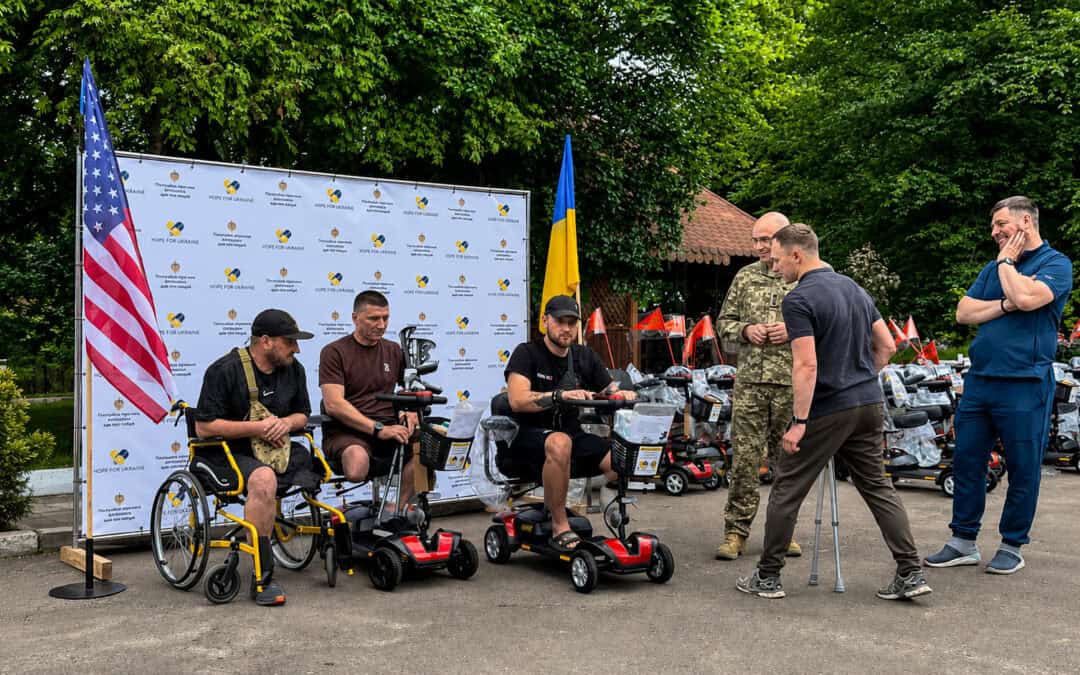
Over 120,000 Ukrainians have been wounded, amputated, or permanently disabled defending their country from Russia’s invasion. For many of them, the war didn’t end when they left the front. It continued in a different form: the inability to get out of a chair, walk to the kitchen, or get themselves to a doctor’s appointment. Hope For Ukraine is providing electric mobility scooters to wounded defenders, and what sounds like a practical donation is something much more than that. It’s giving people back the right to move through their own lives.
What 120,000 Amputees Actually Means
The Ukrainian Ministry of Health estimated that by mid-2024, 100,000 amputations had been performed as a direct result of the war. More recent projections, including figures cited by Hope For Ukraine’s own amputation crisis page, put the number above 120,000, with the true figure likely higher since official statistics are withheld for military security reasons.
According to Ukraine’s Pension Fund, as of January 1, 2025, there are 365,999 registered war veterans, including more than 121,000 with disabilities.
Those are hard numbers to absorb. But behind each one is a specific, ordinary reality: a man who used to drive a truck and now can’t get from the bedroom to the bathroom on his own. A woman who ran a small business and now depends on family members to take her outside. A 23-year-old who lost a leg near Bakhmut, came home to Lviv, and spent months trying to figure out how to live in a body that didn’t feel like his anymore.
Mobility is how people inhabit their own lives. When it’s taken away, everything else gets harder: healthcare, family relationships, mental health, and the basic human need to feel like a person rather than a patient.
The System Is Not Keeping Up
Ukraine’s rehabilitation infrastructure was never built to handle what the war has produced. According to the World Health Organization, only 4% of hospitals in Ukraine provide inpatient rehabilitation care, and prosthetics and orthopedic services are available in less than 1% of medical facilities.
The financial gap is severe as well. Modern bionic limbs can cost between $7,000 and more than $50,000, placing them out of reach for families already dealing with displacement, lost income, and ongoing medical costs.
And even when a defender is ready and eligible for a prosthetic, the process is not simple. According to research from the New Lines Institute, wounded soldiers must compile 12 separate documents before they can be fitted with a prosthesis. More than 18 government authorities at various levels provide veterans’ benefits, creating a system with no clear center of accountability. Reports from veteran communities describe institutional delays, missing equipment, and funds earmarked for rehabilitation that never arrive at the people who need them.
This is the reality on the ground: a system that is not just strained but structurally unable to meet the demand that three years of war has created.
Why a Mobility Scooter Is Not a Consolation Prize
It would be easy to misread what Hope For Ukraine is doing here. A scooter sounds like a workaround, a second-best option for defenders who couldn’t get a prosthetic. That’s the wrong way to see it.
A prosthetic is the long-term goal for many defenders, but it is not always available, not always appropriate for every injury, and not always sufficient on its own. Defenders waiting months for prosthetics still need to move today. Defenders with bilateral amputations or complex multi-limb injuries need different solutions entirely. Defenders in early recovery phases need mobility before they’ve completed rehabilitation. Some defenders will need long-term assistive support regardless of what prosthetics are available to them.
Access to assistive devices, including mobility aids, has emerged as one of the most underprovided areas in Ukraine’s response to its wounded veteran population, according to research published in peer-reviewed medical literature. The gap between what is needed and what is available is particularly acute in conflict-affected areas.
An electric mobility scooter fills a specific and immediate gap. It gets someone to their medical appointment. It lets them go outside on their own for the first time in weeks. It’s the difference between waiting in a room and moving through the world. For a defender who gave their body defending their country, that difference is not small.
The Link Between Mobility and Mental Health
The physical injury is only one part of the crisis. Research from the Portrait of a Veteran 2025 study, conducted jointly by the Rating Group and the Ukrainian Veterans Fund, found that 84% of respondents identified psycho-emotional instability as a likely challenge after service, and 79% pointed to substance abuse as a serious concern.
Immobility makes both worse. When a defender can’t leave the house, can’t participate in family meals, can’t get to a rehabilitation session on their own, the psychological collapse accelerates alongside the physical one. Being stuck is not just physically limiting. It removes people from their own agency, their relationships, their sense of being capable adults.
That’s why mobility support is not separate from mental health support. It’s part of the same intervention. When someone can take themselves somewhere, they’ve reclaimed something the war tried to take from them permanently.
Hope For Ukraine’s Wounded Warrior Project addresses this directly, providing support for the defenders who came home carrying injuries the system was not ready to handle.
What Recovery Can Look Like
In the spring of 2025, a veteran named Mykola competed in his first race on prosthetics, less than a year after his amputation. By summer, he had returned to driving, something he’d spent 20 years doing before the war. A 23-year-old veteran from Lviv, recovering after losing a leg in combat, described the experience of using a prosthesis this way: he sometimes forgot he had lost part of his leg.
These are not inspirational anecdotes designed to soften the story. They’re documentation of what becomes possible when someone has access to the right support at the right time. The gap between where these defenders start and where they can get to is real, but so is the distance they can travel when the right resources are there.
Hope For Ukraine is working to close that gap, one defender at a time.
How You Can Help
The need for electric mobility scooters for wounded Ukrainian defenders is ongoing. More than 120,000 people are living with war-related amputations or disabilities. The rehab system is operating far below the level of need. The documents, the waiting lists, the funding gaps: those problems will not resolve quickly.
What resolves quickly is a scooter arriving at someone’s door. It’s immediate. It’s concrete. It changes a person’s day that same afternoon.
Your donation to Hope For Ukraine helps fund mobility aids, medical support, emergency relief, family support, and direct aid to defenders and civilians affected by the war. Every contribution goes to work in the field.
Donate today and help Hope For Ukraine deliver freedom of movement to the defenders who earned it.
Frequently Asked Questions
Why are electric mobility scooters needed for wounded Ukrainian defenders? Over 120,000 Ukrainians have been wounded or amputated due to the war. Ukraine’s rehabilitation system can handle only a fraction of that need: less than 1% of medical facilities offer prosthetics services. Mobility scooters provide immediate independence for defenders who are waiting on prosthetics, in recovery, or living with injuries that require permanent mobility assistance.
How many Ukrainians have been amputated or disabled by the war? The Ukrainian Ministry of Health estimated 100,000 amputations by mid-2024. More recent figures cited by humanitarian organizations put the number above 120,000, with the actual total likely higher because official statistics are withheld for military security reasons.
What is the process for a wounded Ukrainian defender to receive a prosthetic? According to research from the New Lines Institute, wounded defenders must compile 12 separate documents before they can be fitted with a prosthetic. More than 18 government authorities provide veterans’ benefits, creating a fragmented, slow-moving system. This bureaucratic barrier is one reason organizations like Hope For Ukraine focus on immediate assistive solutions.
What does Hope For Ukraine do for wounded defenders? Through its Wounded Warrior Project, Hope For Ukraine provides direct support for injured defenders, including mobility aids, medical assistance, and rehabilitation resources. The organization also runs a Medical Support Project that delivers aid to frontline medical teams and wounded individuals.
Is a mobility scooter a permanent solution or temporary? Both, depending on the individual. For defenders in early recovery stages, a scooter provides mobility while they work toward prosthetics or other long-term solutions. For defenders with severe bilateral amputations or other complex injuries, a scooter may be part of their long-term daily life. In either case, it restores independence that matters immediately.
How does mobility support affect mental health for veterans? Research from the Portrait of a Veteran 2025 study found that 84% of Ukrainian veterans identified psycho-emotional instability as a major post-service challenge. Immobility accelerates that decline by isolating people from their families, routines, and healthcare. Restoring the ability to move independently is a direct intervention in a defender’s psychological recovery, not just their physical one.